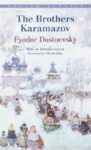
by Fyodor Dostoevsky, 1880
I got this book a long time ago out of a Little Free Library. It’s 936 pages long. I finally took the time to read it this summer because the ‘Faith and Fiction’ guy on IG said, “It’s the greatest defense of Christianity in all of literature…wildfire of a book…within this wildfire, all 3 brothers are burning in totally different directions and it is that intensity that keeps the pages turning…every argument and doubt thrown at Christianity…God is the only answer…absolute certainty and pure brilliance…greatest work of fiction of all time and it points its fingers directly at our Lord and Savior Jesus Christ.” Well, that convinced me to finally read it.
It is set in Russia in the late 1800’s. It concerns 3 brothers of a horrible person, Fyodor Karamazov. The oldest boy, Dmitry, has a good heart and deep passions, and desperately loves a woman, Grushenka. He spurns his first love, beautiful Katerina, for Grushenka. The problem is, his despicable father is also in love with Grushenka, and has offered her 3000 rubles if she will marry him. Dmitry is overcome with jealousy and hatred. Katerina knows he is in love with Grushenka. She gives him 3000 rubles ostensibly to send to some relatives of hers in Moscow, but he takes the money and spends it on a few days of partying with Grushenka. Dmitry desperately wants to repay Katerina and he wants 3000 rubles from his father, which his father rightfully owes him, but his father will not give it to him.
What happens is the despicable father ends up dead, the 3000 rubles ends up stolen, Dmitry is there on the scene with blood on his hands, and ends up arrested for the crime, tried, and convicted, despite the brilliant defense lawyer.
Alexei (Alyosha) is the youngest brother. He is an angel! He loves God and wanted to be a monk, but his beloved mentor tells him he is meant to be in the world. He is the goodness and light in this book.
Ivan is the middle brother. He’s a brooding intellectual and I can’t quite get a read on him. Does he love Katerina, or doesn’t he? Does he believe in God or doesn’t he? He ends up knowing who killed their father (the illegitimate epileptic son, Smerdyakov) because Smerdyakov reveals all to him the night before the trial, and throws the 3000 rubles to Ivan, before hanging himself. Ivan tries to tell the court on the witness stand that it was Smerdyakov, but he has the beginnings of a brain fever and they don’t believe him.
It is a rollicking tail and not as painful to read as Crime and Punishment, but also not as good, I think.
There are many good nuggets I will take with me from this book, which I will add to this book report in the coming months.
Pg 381: “A child needs sunshine, he needs to play with other children, he needs someone to set him a good example, and above all he needs love, even if it is only a tiny drop of love.” This is the most memorable thing I took from this book.
[The second thing I learned from this book – “Always choose humble love, always.”]
[The third thing – examine yourself – make sure you aren’t showing rage – especially in front of a child. You can sow an evil seed in the child.]
[The fourth thing I learned from this book – the idea of hell being “the suffering of one who can no longer love.]
[The fifth thing I learned from this book: “As long as he thinks of the offenses he has suffered, he will always be turning off into back alleys..But there is a bright, wide open road, a straight road, shining like crystal, leading to the sun…“]
Pg 20: Alyosha (the third son) had come to love his fellow man early in life.
Pg 21: He refused to sit in judgment on others. He would walk away from the debauchery in his father’s house, “but never show the slightest sign of scorn or condemnation.”
Pg 22: His father loved Alyosha – but it might have been the “besotted sentimentality” of drunkenness.
Pg 22: Alyosha “never held a grudge when someone offended him. An hour later, he would answer the offender or speak to him himself, with a trustful, friendly look, as if nothing had happened. And it wasn’t that he had forgotten or, having thought it over, had decided to forgive the insult; it was simply that he no longer felt offended.”
The eldest son was Mitya (Dmitry). He was wild and wanted his inheritance. He was the son of Adelaida, the first wife.
The second son was Ivan, of Sofia, the 2nd wife – very young.
The third son was Alexei (Alyosha), also of Sofia. Sofia went mad and died. The two little boys were adopted by a generous and honorable man, Mr. Polenov. Ivan was brilliant, a scientist and writer, wrote a piece about the ecclesiastical courts. Alexei was an angel in every way. Not simple-minded or naive, “refused to sit in judgment on others.” Not greedy or lustful. Loved people. Lived in monastery.
Pg 50: The Elder, Zosima, at the monastery to visiting scoundrel, Fyodor Karamazov and Miusov: ‘feel completely at home. do not be ashamed of yourself for that is what causes all the trouble.’
Pg 51: “The important thing is to stop lying to yourself. A man who lies to himself, and believes his own lies, becomes unable to recognize truth, either in himself or in anyone else, and he ends up losing respect for himself as well as for others. When he has no respect for anyone, he can no longer love and, in order to divert himself, having no love in him, he yields to his impulses, indulges in the lowest forms of pleasure, and behaves in the end like an animal, in satisfying his vices. And it all comes from lying–lying to others and to yourself. A man who lies to himself, for instance, can take offense whenever he wishes, for there are times when it is rather pleasant to feel wronged–don’t you agree? So a man may know very well that no one has offended him, and may invent an offense, lie just for the beauty of it, or exaggerate what someone said to create a situation, making a mountain out of a molehill…”
Pg 54 – crazy, wailing Russian women, believed to be acting that way in order to avoid work, but he learned later, it was a sickness caused by “exhausting work following too soon upon a difficult, abnormal labor without medical help, and from an intensely unhappy life, full of brutality and ill-treatment, which, although common enough, is beyond the powers of endurance of some women.”
Pg 56-58: A weeping mother who lost her little 3 year old boy, her 4th child lost! How the elder comforts her: “I’m sad about my little boy, Father…He would have been three in two months. I miss my little son, my sweet baby, my last. We had four, Nikita and I, but we can’t seem to keep them, our little ones, they just won’t stay, dear Father, they just won’t…When I buried the three older ones, I didn’t grieve too much for them, but this last one–I can’t get him out of my head…” He tells her the story of a mother who lost her son in ancient times and went to a saint. The saint told the woman: “you must rejoice instead of weeping, mother, because your little one is now with the Lord among the angels.” That’s what her husband tells her but he’s crying while he tells her this. And she says, “Where else would he be, if not with the Lord? But then he’s not here with us anymore. He’s not by my side as he used to be.’ If only I could see him just once more! I wouldn’t even go up to him, or say a word to him….If only I could see him and hear him playing, just for a minute, outside in the yard–and then come into the house as he used to and call out in his little voice…If only I could hear his little feet walking across the room, if only once more, his tiny, tiny steps…Ah, I remember how often he used to run up to me, squealing and laughing–if only I could hear his little footsteps…But he’s gone, Father, I’ll never hear his steps again…” The elder says she is being like Rachel in the Bible who refused to be comforted. “Such is the lot of mothers on Earth. So do not be comforted–there is no need. Weep, but every time you do, remember that your little son is one of God’s angels, that he is looking down on you from where he is now, that he sees you and rejoices in your tears and shows them to God. You will shed a mother’s tears for a long time to come, but in the end your weeping will turn into quiet joy, and your bitter tears will come tears of quiet tenderness which will cleanse your heart of sin. … For he is alive, very much alive, since the soul lives forever.”
Pg 59: “There is not – there cannot be – a sin on Earth that God will not forgive the truly repentant.”
Pg 60: “Love redeems and saves everything.”
Pg 66: “Above all, avoid lying…Avoid disgust…whatever strikes you as disgusting within yourself is cleansed by the mere fact that you notice it. Avoid fear too, although fear is really only a consequence of lies…”
Pg 71 – Ivan’s article re: church and state – “It is not up to the Church to seek a proper place for itself within the State…Since ultimately every secular state is to be integrated into the Church and become nothing but the Church, it is the State that must discard all goals that are incompatible with those of the Church.”
Pg 77 – “A Christian socialist is much more dangerous than an atheistic socialist.”
Pg 99 – they served kvas at the luncheon the Monastery arranged for Fyodor Karamazov and his son, Dmitry, and others. Karamazov acted “scandalously.” Here is described the luncheon: “It was not really a dining room, since the Father Superior had only two rooms altogether. They were larger and more comfortable than the elder’s, but their furnishings were not very lavish either: the chairs were mahogany covered with leather in the old style of the 1820’s and the floors were not even stained, but everything was spotlessly clean and there were beautiful flowers in the windows. The chief luxury, on this occasion, of course, was a sumptuous table laden with choice foods, although even that luxury was relative: the tablecloth was immaculate, the plates and the silverware shone; there were three kinds of freshly baked bread, two bottles of wine, two bottles of the monastery’s excellent mead, and a large jug of its kvas, which was famous throughout the district. No vodka was served at all.” Kvass (spelled with two s’s on Google) is a low alcohol, fermented beverage made with dark rye bread or rye flour, common in Slavic and Eastern European countries, dating back 1000 years. Alcohol content is only 1-2%. It’s cloudy, tastes malty, sweet and sour, and is sometimes compared to lemonade.
Pg 101: Karamazov shows up late to the Father Superior’s luncheon, after he had already disgraced himself in the Elder’s room. “He remembered what he himself had said in the elder’s cell: that whenever he appeared among people, he always felt they considered him the most despicable of men and that his usual reaction at those moments was to say to himself, “Well, if that’s so, I’ll act like the fool they think I am and show them that in reality they are stupider and more despicable than I am.” And he felt an urge to punish the others for his own disgusting display. He also remembered that when someone had once asked him, “Why do you hate so-and-so so much?” he had answered in a fit of shameless buffoonery: “True, the fellow has never wronged me, but I have wronged him in the most disgusting, unscrupulous manner, and I have hated him ever since.” This is after the Father Superior had said the most loving things including that if Karamazov had shared lunch with them, perhaps he would have learned to love them the way they loved him. Pg 100: “I am very sorry that the gentleman has decided not to come. Perhaps by sharing this meal with us, he would have learned to love us as we love him. And now, gentlemen, please be seated.” (That is when Karamazov decided to show up and ruin everything.)
Pg 109 – describing Gregory, Karamazov’s loyal servant, whom he needed to be near him when he was overcome with mental anguish, guilt, and torment. “In the course of Karamazov’s life there had been many occasions when he had been in danger of being beaten, sometimes quite badly, but every time Gregory came to his rescue, although afterward the old servant would always admonish him at great length. But Gregory meant much more to Karamazov than a means of avoiding beatings; there were moments when, for some complex and subtle reasons that he himself could not explain, he felt an urgent and pressing need to have someone loyal and trustworthy by him. Some of these times were of a rather morbid nature: debauched in his sensuality and often cruel, like some vicious insect, Karamazov was occasionally, especially when drunk, subject to moments of mental anguish, of torment arising from a feeling of guilt that made him feel his soul was hurting him physically, so to speak.”
Pg 110: “When Alyosha came to live with his father, Mr. Karamazov felt rather the same way about him. Alyosha “touched his very heart by being there, seeing everything, condemning nothing.” Moreover, Alyosha offered his father something that he had never had before — a complete absence of contempt for him.”
Pg 117 we meet Smerdyakov. He was born to “Reeking Lizaveta” who died in childbirth. Gregory brought the infant home to his wife, Martha, who had just lost a child. They christened him Paul, but Karamazov called him Smerdyakov – the Reeking One. Gregory and Martha raised him and he was living with them in the servant’s quarters. He was Karamazov’s cook.
Pg 154, Karamazov calls Smerdyakov a casuist and an anathema. Casuist: “A casuist is a person who resolves moral or ethical problems by applying general principles to specific, real-life cases, or, more commonly in modern usage, someone who uses clever, deceptive, or overly subtle reasoning to rationalize behavior or mislead others.” (from Google). Anathema: An anathema is something or someone that is intensely disliked, loathed, or considered completely wrong and offensive. Also from Google.
Pg 177, Alyosha sees Grushenka for the first time and is struck by her beauty. “But then, in all fairness, it must be said, she was very, very beautiful and her beauty was that typical Russian beauty that inspires passion in so many men. Grushenka was not quite so tall as Katerina, who was very tall indeed. Her body was strong and full and, when she moved, her movements were so light that they seemed inaudible. And, as in her voice, there was perhaps something too provokingly tender, perhaps a touch of deliberate seductiveness, in her movements. Unlike Katerina, whose step was quick and energetic, Grushenka walked noiselessly: her feet touched the floor without a sound. She slid smoothly into an armchair with a soft rustle of her sumptuous black silk dress, drawing an expensive black cashmere shawl delicately around her strong white neck and wide shoulders. She was twenty-two and she looked exactly her age. Her complexion was very fair and her cheeks delicately rosy. Her face was rather broad at the temples and her lower jaw protruded, although only very slightly. Her upper lip was much thinner than the lower, which was quite full. But her magnificent, abundant, dark-brown hair, her sable eyebrows, and her beautiful blue-gray eyes with their long lashes were certain to stop even the last interested, most absentminded man who met her in the street or saw her in a crowd, even if he was in a hurry–he would not be able to help staring at her and remembering her for a long time. What struck Alyosha most about her face was its child-like, trusting expression. She looked like a child who is delighted about something and, as she came toward the table, she looked just that — delighted, as though she expected something nice to happen and was full of curiosity and trusting anticipation.”
Pg 190, Zosima, the beloved Elder monk, is going to bed: “But before he went to sleep, he threw himself down on his knees and prayed for a long time. In his fervent prayer, he did not ask God to clear up his confusion, but only sought the rapture he always experienced in the glorification of God, of which his nightly prayers consisted.”
Pg 191, Alyosha’s prayer: “Have mercy upon them all, O Lord. Save them, the unhappy and the tormented. Guide them onto the path that is right for each one of them, according to Your wisdom. You are love. You will bring joy and happiness to all. . .”
Pg 196, Elder Zosima’s last prayer: “Love one another… We are no holier than those outside…”
Pg 204-205, Father Paisii is explaining to Alyosha that his place is not in the monastery but in the secular world: “And in the hearts of the very atheists who are trying to destroy everything, that spiritual emotion lives on to this day. This is so because even those who have renounced Christianity, even those who rebel against it–even they, in their essence, were created in the image of Christ and have remained in His image. Their combined wisdom and their desperate efforts to create a nobler man with greater dignity, the ideal set by Christ, have come to naught. From all their attempts, only freaks have resulted.”
Pg 283, Ivan to his younger brother, Alyosha: “I want you to understand that it is not God that I refuse to accept, but the world that He has created–what I do not accept and cannot accept is the God-created world. However, let me make it clear that, like a babe, I trust that the wounds will heal, the scars will vanish, that the sorry and ridiculous spectacle of man’s disagreements and clashes will disappear like a pitiful mirage, like the sordid invention of a puny, microscopic, Euclidean, human brain, and that, in the end, in the universal finale, at the moment universal harmony is achieved, something so magnificent will take place that it will satisfy every human heart, allay all indignation, pay for all human crimes, for all the blood shed by men, and enable everyone not only to forgive everything but also to justify everything that has happened to men.”
Pg 285, Ivan is still talking with Alyosha: “The idea of loving one’s neighbor is possible only as an abstraction: it may be conceivable to love one’s fellow man at a distance, but it is almost never possible to love him at close quarters….
“…it is possible to love children, at close quarters, even if they are dirty, even if they have ugly faces, although to me a child’s face is never really ugly….No innocent should be made to suffer for another man’s sins, especially innocents such as these!”
Pg 286 “People often describe such human cruelty as bestial, but that’s, of course, unfair to animals, for no beast could ever be as cruel as man.” Ivan is telling Alyosha all of the horrible acts of adults towards children.
Pg 294: “No, I want to see with my own eyes the lamb lie down with the lion and the resurrected victim rise and embrace his murderer. I want to be here when everyone understands why the world has been arranged the way it is. It is on that craving for understanding that all human religions are founded, so I am a believer. But then, what about the children? How will we ever account for their sufferings? For the hundredth time I repeat, there are many questions that could be asked, but I ask you only one — about the children — because I believe it conveys fully and clearly what I am trying to tell you.”
Pg 295 – Ivan still talking to Alyosha, he cannot get over the hurdle – the suffering of innocent children. “But that’s just the hurdle I can’t get over, because I cannot agree that it makes everything right.”
Pg 296: Alyosha answers Ivan’s argument with Jesus. Ivan: “And do you find acceptable the idea that those for whom you are building that edifice should gratefully receive a happiness that rests on the blood of a tortured child and, having received it, should continue to enjoy it eternally?”
“No, I do not find that acceptable,” Alyosha said and his eyes suddenly flared up. “But a moment ago you asked whether there was in the world ‘a single creature who could forgive.’ Well, there is. And He can forgive everyone for everything, because He Himself gave His innocent blood for everyone’s sins and for everyone’s sake. You forgot to mention Him, although it is on Him that the edifice must be founded, it is to Him that they will sing, “You were right, O Lord, for Your ways have now been revealed to us!'”
This type of suffering – cruelty to innocents – is the worst kind of evil. I believe that Jesus is with the innocent sufferers in a way we cannot comprehend. Also, I believe those who harm them will suffer extreme wrath of God if they do not repent.
In the Pro and Contra Chapter, The Grand Inquisitor, Ivan is telling a story about Jesus coming down during the Inquisition and the Cardinal, The Grand Inquisitor, has Him arrested.
Pg 306: “In their efforts to impose universal worship, men have unsheathed their swords and killed one another. They have invented gods and challenged each other: “Discard your gods and worship mine or I will destroy both your gods and you!” (The Church talking to Jesus.)
Pg 309, the Church still talking to Jesus: “We have corrected Your work and have now founded it on miracle, mystery, and authority. And men rejoice at being led like cattle again, with the terrible gift of freedom that brought them so much suffering removed from them.”
Pg 310, the Church still talking to Jesus: “You look at me silently with those gentle eyes of Yours? Be angry with me. I do not want Your love, because I do not love You myself. Why should I go on pretending that I do not know to whom I am speaking? Everything I have to say You already know–I can read it in Your eyes. How could I expect to hide our secret from You? But perhaps you want to hear it from my own lips. Listen then: we are not with You, we are with him – and that is our secret, our mystery! We have been with him and not with You for a long time, for eight centuries already. Exactly eight centuries ago we accepted from him what You had rejected with indignation, the last gift he offered You — all the kingdom of earth. We accepted Rome and Caesar’s sword from him, and we proclaimed ourselves the sole rulers of the Earth, although to this day we have not yet succeeded in bringing our work to final completion….Had You accepted the third offering of the mighty spirit, You would have fulfilled man’s greatest need on earth. That is, the need to find someone to worship, someone who can relieve him of the burden of his conscience, thus enabling him finally to unite into a harmonious ant-hill where there are no dissenting voices, for the unquenchable thirst of universal unity is the third and last ordeal of man. Men have always striven to be organized into a universal whole….The great conquerors, the Tamerlanes and the Genghis Khans, who swept like whirlwinds across the earth, striving to subdue the whole world, were also, even if they were unaware of it themselves, obeying that eternal human craving for universal union.”
Pg 315, Alyosha tells Ivan, “Their only secret is their godlessness, and your inquisitor’s only secret is that he doesn’t believe in God, that’s all!”
Pg 316: “Here’s how I propose to end it,” Ivan said, continuing.
“The Grand Inquisitor falls silent and waits for some time for the prisoner to answer. The prisoner’s silence has weighed on him. He has watched Him; He listened to him intently, looking gently into his eyes, and apparently unwilling to speak. The old man longs for Him to say something, however painful and terrifying. But instead, He suddenly goes over to the old man and kisses him gently on his old, bloodless lips. And that is His only answer. The old man is startled and shudders. The corners of his lips seem to quiver slightly. He walks to the door, opens it, and says to Him, ‘Go now, and do not come back… ever. You must never, never come again!’ And he lets the prisoner out into the dark streets of the city. The prisoner leaves.”
Pg 317-318: Alyosha is asking Ivan how he intends to continue living with the hell that is in his head and in his heart, and Ivan says he’s got the Karamazov drive — the vile, earthly drive. Alyosha says, “By that you mean you’ll act as if ‘everything is permitted’? For you feel that’s true-whatever you do is all right?”…
“Ah, my little Alyosha, I thought that when I left this town you would be the only friend I had in the world,” Ivan said with sudden feeling, “but now I realize that there is no rrom for me even in your heart, my dear recluse. Well, I won’t go back on my idea that everything is permitted’, but then, will you, too, turn your back on me?”
“Alyosha stood up, walked over to him, and without a word, kissed him on the lips.
“That’s plagiarism!” Ivan shouted, suddenly beaming with delight. …
“Know what, Alyosha?” Ivan said with deliberation. “If I last long enough to get around to the sticky little leaves, I will love them only thinking of you. The thought that you are somewhere here will be enough for me not to lose all desire to live…”
Pg 319-320: “As to Ivan, a strange and violent anxiety descended upon him as he left Alyosha, setting out for his father’s house. And the closer he came to the house the more intense the anxiety became. It was not the anxiety in itself that was so strange but the fact that, hard though he tried, Ivan was quite unable to explain what it consisted of. He had often before known moments of anxiety and depression and there was nothing surprising in his feeling this way at a moment when he was about to break with everything that had brought him here and start on a completely new and unknown course–a course that he would follow all alone as before, full of hope without knowing what he actually hoped for, and expecting a great deal, perhaps too much, from life without being able to define what he expected or even what he wished for. But now, although he was worried about the unknown new life that lay ahead of him, that was not what filled him with this strange anxiety. “Can it be the revulsion I feel for father’s house?” he thought. “Perhaps, for although I know that this will be the last time I enter that revolting place, I cannot help feeling sick…” But no, it wasn’t that either. Could it possibly be his conversation with Alyosha and their parting just now? “After all these years of silence, when I wouldn’t talk to anyone about those things, I suddenly let myself go and rattled off all that stupid nonsense…” Perhaps it was his irritation at himself, at his callowness and immature vanity, his annoyance at having failed to express himself properly, especially to such a one as Alyosha, who certainly figured importantly in Ivan’s view of his future. Of course that was part of it–his annoyance with himself–but that still was not really it. “This anguish makes me feel physically sick, but I’m entirely unable to say what I want. Perhaps I ought to try not to think about it at all..”
“He tried not to think of it, but that did not help either. The most irritating thing about it was that the anxiety seemed completely accidental, external, as if it had nothing to do with him. Something was disturbing his conscience, just as some object may irritate a person, when he is absorbed in work or a heated argument, without his being aware of it….
“…Then suddenly, when he was only fifty feet or so from the gate, he finally succeeded in identifying the object that had caused him to feel such acute anxiety.
“Smerdyakov sat on the bench by the garden gate, enjoying the cool evening air, and Ivan at once realized that it was this man who had been weighing on his mind, that he could not bear the very idea that this creature existed…”
Pg 348, Markel, the elder Zosima’s older brother, used to be an unbeliever but got very sick and came to repent of his ways and cherish his life on earth, the beauty around him, and all the people around him. “The windows of my brother’s room gave onto our garden, which was full of shady old trees in which the young spring birds were chirruping and singing. And as he watched and admired the little birds, he suddenly started to ask them, too, to forgive him: “God’s little birds, please forgive me, for I have sinned before you, too.” Now that was something nobody could really understand. But Markel lay there with tears of joy rolling down his cheeks. “Yes,” he explained, “I used to be surrounded by the glory of God–the birds and the trees and the fields and the sky–and I alone lived in degradation. I was the only one who was an insult to everything, and I didn’t even notice all the beauty and the glory of the world.”
Pg 351, the Elder Zosima is talking about Job, a story he fell in love with as an 8-year old. “…There is so much in it that is great, mysterious, inconceivable!
“Later I was to hear sarcastic and blasphemous remarks about it, words full of conceit: Why should God give the most beloved of His saints to Satan so that he could play games with him, take away his children, smite him with sores and boils from which he would scrape the pus with a potsherd? Was it simply to enable Him to boast to Satan later and say to him something like, “See how My saint can suffer for My sake?” But then the very greatness of the story lies precisely in its mystery–here fleeting, earthly reality confronts eternal truth. Just as in the first days of creation when the Creator, at the end of each day, paused to admire His work with the words, “That which I have created is good!”–so in this story He looks at Job and again praises His creation. And Job, when he praises the Lord, serves not only Him but His whole creation, for generations and generations, forever and ever, for that is what he was foreordained to do.
“Oh, what a great book it is and how much we learn from it! What a miraculous book is the Holy Bible and what strength it gives to man! It is like a sculpted model of the world, of mankind, and of the characters of men; everything is there and it contains guidance for us for all ages. How many mysteries are solved in it, how many revealed!
“And so God raised Job up and gives him back his wealth, and many years pass. Job again has children, new children, whom he loves. But how can he possibly love these new children of his when the others are no longer there, when he has lost them? Can he be completely happy when he remembers his dead children, however dear to his heart his new children may be? But he can be happy, he can know happiness again, because a mysterious process gradually transforms an old grief into a quiet happiness; seething youth is replaced by gentle and serene old age. Every day I bless the rising sun and my heart sings to it as it did before; but now I love the sunset even more, and its long, slanting rays bring back to me quiet, touching, tender memories, dear faces, and images from my long and blessed life. Over everything there hovers the Lord’s truth and justice, that moves our hearts, reconciles everything, and is all-forgiving!”
Pg 354: “A Nation is lost without the Word of God, for every human soul thirsts for His Word and for the good and the beautiful.”
Pg 354: “…It was a clear, still, warm night in July. A cool mist was rising from the broad river. The birds had quieted down and now and then a fish would splash in the water. Everything was hushed and beautiful, praying to God as it were. Only the two of us, the boy and I, were not asleep, as we talked about the beauty of this world of God’s and of the great mystery in it. Every blade of grass, every bug, every ant, every golden bee, knowing so amazingly what to do, without intelligence, reveals the existence of God’s mystery and continuously demonstrates it to us.”
Pg 355: “…Look at these animals–what meekness, what devotion to man, who often beats them mercilessly, what gentleness and trustfulness there is in them–and that is so beautiful! It is so moving to think that these creatures are free of sin, because all but man are sinless and Christ was with them even before He came to us.”
“Do you mean,” the boy asked, “that Christ is with them too?”
“How could it be otherwise,” I said, “since the Word is for all creation, and every creature and every little leaf obeys the Word, singing the praises of God, weeping to Christ and, all unaware, accomplishing it all by the mystery of its sinless existence…”
“…May God bless the young! Before I went to sleep myself, I prayed for him. O Lord, send peace and light to Your people!”
Pg 356 – 363, Zosima’s conversion from unkind debauchery to love…great story.
Pg 359: “Why should another man, made in the image of the Lord, just like me, be my servant?” It was the first time this question had arisen in my mind. And I remembered my brother Markel saying, “Mother, my own dear blood, every one of us is answerable for everyone else, but we don’t know it; if we did, we would at once have heaven on earth!”
Pg 362-363: “But how can you possibly be responsible for everyone?” people would say, laughing at me openly. “How could you be responsible for our acts, for instance?”
“How can you understand,” I told them, “when the whole world has been running on false ideas for so long, when we accept unmitigated lies as truth and demand lies of others…”
Pg 365: “We would have become very close friends if he had spoken to me about himself, but he practically never said a word about his private affairs; he only seemed interested in talking about me.”
Pg 366: The mysterious visitor: “So to your question when heaven on earth will come about, I can only promise you that it will come without fail, but first the period of man’s isolation must come to an end.”
“What isolation?” I asked him.
“The isolation that you find everywhere, particularly in our age. But it won’t come to an end right now, because the time has not yet come. Today everyone asserts his own personality and strives to live a full life as an individual. But these efforts lead not to a full life but to suicide, because, instead of realizing his personality, man only slips into total isolation. For in our age mankind has been broken up into self-contained individuals, each of whom retreats into his lair, trying to stay away from the rest, hiding himself and his belongings from the rest of mankind, and finally isolating himself from people and people from him. And, while he accumulates material wealth in his isolation, he thinks with satisfaction how mighty and secure he has become, because he is mad and cannot see that the more goods he accumulates, the deeper he sinks into suicidal impotence. The reason for this is that he has become accustomed to relying only on himself; he has split off from the whole and become an isolated unit; he has trained his soul not to rely on human help, not to believe in men and mankind, and only to worry that the wealth and privileges he has accumulated may get lost. Everywhere men today are turning scornfully away from the truth that the security of the individual cannot be achieved by his isolated efforts but only by mankind as a whole.
“But an end to this fearful isolation is bound to come and all men will understand how unnatural it was for them to have isolated themselves from one another. This will be the spirit of the new era and people will look back in amazement at the past, when they sat in darkness and refused to see the light. And it is then that the sign of the Son of Man will appear in the heavens…But until that day we must keep hope alive, and now and then a man must set an example, if only an isolated one, by trying to lift his soul out of its isolation and offering it up in an act of brotherly communion, even if he is taken for one of God’s fools. This is necessary, to keep the great idea alive.”
Pgs 378-379, Teachings of the Elder Zosima: “…Look at the worldly, at those who set themselves above the people of God–have they not distorted the image of God and His truth? They have science, but science contains nothing that does not come through the senses. The spiritual world, the nobler side of man’s being, has been rejected altogether, banned as it were triumphantly, perhaps even with hatred. The world has proclaimed freedom, now more loudly than ever; but what do we find in that freedom of theirs? Nothing but enslavement and suicide! The world says: “you have needs–satisfy them. You have as much right as the rich and the mighty. Don’t hesitate to satisfy your needs; indeed, expand your needs and demand more.” This is the worldly doctrine of today. And they believe that this is freedom. The result for the rich is isolation and suicide, for the poor, envy and murder; for while the poor have been handed all these rights, they have not been given the means to enjoy them. … People are more and more moved by envy now, by the desire to satisfy their material greed, and by vanity…”
Pg 379-380: “So it is not surprising that, instead of freedom, they lapse into slavery, that, instead of promoting unity and brotherhood, they encourage division and isolation, as my mysterious guest and teacher explained to me in my youth. That is why the idea of service to mankind and brotherly love has been dying out in the world; indeed, now it is often sneered at, for what can a man do who has become the slave of the innumerable needs and habits he has invented for himself? He lives in his separate little world and does not care about the great world outside. The result of all this is that, today, when more material goods have been accumulated than ever, there is less joy.”
Pg 381: “A child needs sunshine, he needs to play with other children, he needs someone to set him a good example, and above all he needs love, even if it is only a tiny drop of love.” This is the most memorable thing I took from this book.
Pg 384-385: “Or do you think that it is a vain hope that one day man will find joy in noble deeds of light and mercy, rather than in the course pleasures he indulges in today–gluttony, fornication, ostentation, boasting, and envious vying with his neighbor?”
…”When will you build your own edifice and organize your life justly by reason alone and without Christ?”…The truth is that they indulge in wishful thinking much more than we do. In trying to bring about a just society without Christ, they will end up by flooding the world with blood, for blood cries out for more blood and he who lives by the sword shall perish by the sword. And if it were not for Christ’s solemn promise, they would annihilate one another down to the last two men on earth. Then, in their pride, even these two would be unable to restrain each other and the last man would destroy the last but one, and then kill himself. That is how it would end were it not for Christ’s solemn promise that, for the sake of the meek and the humble, it will never happen.”
Pg 385-386: “Do not forget to pray, my boy. If your prayers are truly sincere, every day a new fervor will appear, a new thought of which you were unaware before, and that will give you new strength. You will understand then that prayer is education. Remember this, too. Repeat to yourself every day and as often as you can: “O Lord, have mercy on all those who will appear before You today.” For every hour, every second, thousands of men leave this world and their souls appear before the Lord, and no one knows how many of them leave this earth in isolation, sadness, and anguish, with no one to take pity on them or even care whether they live or die. And so your prayer for such a man will rise to the Lord from the other end of the Earth, although he may never have heard of you or you of him. But his soul, as it stands trembling before the Lord, will be cheered and gladdened to learn that there is someone on earth who loves him. And the Lord’s mercy will be even greater to both of you, for, however great your pity for the man, God’s pity will be much greater, for He is infinitely more merciful and more loving that you are. And God will forgive him for your sake.
“Brothers, do not fear man’s sins. Love man in his sin too, for such love resembles God’s love, the highest possible form of love on earth. Love God’s creation, love every atom of it separately, and love it also as a whole; love every green leaf, every ray of God’s light; love the animals and the plants and love every inanimate object. If you come to love all things, you will perceive God’s mystery inherent in all things; once you have perceived it, you will understand it better and better every day. And finally you will love the whole world with a total, universal love.
“Love the animals: God has given them the beginnings of thought and untroubled joy. So do not disturb their joy, do not torment them, do not deprive them of their well-being, do not work against God’s intent. Man, do not pride yourself on your superiority to the animals, for they are without sin, while you, with all your greatness, you defile the Earth wherever you appear and leave an ignoble trail behind you–and that is true, alas, for almost every one of us!
“Above all, love little children, for they are sinless, like little angels, and they are there to arouse our tenderness, to purify our hearts, and in a sense to guide us. Woe to the man who offends a small child!…
“There will be moments when you will feel perplexed, especially in the presence of human sin. You will ask yourself: “Must I combat it by force or try to overcome it by humble love?” Always choose humble love, always. Loving humility is a powerful force, the most powerful, and there is nothing in the world to approach it.
“Every day, every hour, every moment, examine yourself closely and see that your appearance is seemly. You may, for instance, pass a small child; your face may be angry, you may be uttering wicked words, and there may be rage in your heart; you may not even notice the child, but as long as the child sees you in that state, that unseemly and ugly picture may become engraved in his innocent little heart. So, without knowing it yourself, you may thus have sown an evil seed, which perhaps will sprout within the child, and all simply because you failed to control yourself before the child, because you failed to cultivate within yourself a considerate and active love for others. Brothers, love is a teacher, but a hard one to obtain; learning to love is hard and we pay dearly for it. It takes hard work and a long apprenticeship, for it is not just for a moment that we must learn to love, but forever. In anyone, even the wicked, love can be kindled by chance.”
[The second thing I learned from this book – “Always choose humble love, always.”]
[The third thing – examine yourself – make sure you aren’t showing rage – especially in front of a child. You can sow an evil seed in the child.]
Pg 387: “My friends, pray to God for joy. Be joyful like children, like the birds. Do not be discouraged in your efforts by men’s sins; do not fear that they will obliterate your work and prevent its fulfillment; do not say, “Sin, wickedness, and bad environment are too much for us–we are alone and helpless against them, and the surrounding evil will not allow us to accomplish our good works.” Rid yourselves of that despair, children! There is one way for you to overcome these obstacles: take firm hold of yourselves and make yourselves answerable for all men’s sins. This is also the truth, friends! For as soon as a man sincerely accepts the idea that he is answerable for the sins of all men, he will realize that that is, indeed, the truth, that he is answerable for everybody and everything. But if you seek excuses for your idleness and impotence by blaming other people, you will end up bloated with Satan’s pride and murmuring against God. And this is what I think of Satan’s pride: it is difficult for us on earth to perceive it and so we readily slip into error, become contaminated by it, and then delude ourselves that we are performing great and admirable deeds. Besides, there are many human emotions and twists in human nature that men on earth are still unable to understand. But do not be tempted and do not try to use ignorance as an excuse for yourself, for the Eternal Judge will only call you to account for what you can understand, not for what you cannot, and by then you will see everything in the true light and you will not protest.”
Pg 388: “…we have been given a mysterious, sacred sense of a living bond with another world, with a lofty and superior world; and, indeed, the roots of our thoughts and feelings are not in the Earth but in other worlds. That is why the philosophers say it is impossible for us on earth to grasp the essence of things. God took the seeds of other worlds and sowed them on this earth and they sprouted in His garden; everything that could grow, did. And all that has grown remains alive and lives by its awareness of its ties to other, mysterious worlds, and if that awareness weakens or dies in you, then all that has grown within you will also die. And you will become indifferent to life, will even come to hate it. That is what I believe.”
Pg 388: “Above all, remember that you cannot be anyone’s judge. No man on earth can judge a criminal until he understands that he himself is just as guilty as the man standing before him and that he may be more responsible than anyone else for the crime. Only when he has understood this can he become a judge. Absurd though it may sound, this is the truth. For it is possible that, if I myself had been upright this man would not be standing before me accused of a crime.”
Pg 389: “If the evil deeds of men sadden you too greatly and arouse in you an anger you cannot overcome and fill you with the desire to wreak vengeance on the evil-doers–fear this feeling most of all, and at once go and seek suffering for yourself, because you too are responsible for the evil deeds of all men. Bear that ordeal and your desire for revenge will be quenched when you understand that you were guilty yourself for having failed to show the light to the wicked, as a man without sin could…And even if you lighted his way but still did not manage to save the evil-doer, keep the faith, never doubt the power of the heavenly light, and have faith that if they are not saved now, they will be saved later…”
Pg 389-390: “What you do, do for the whole world, and work for its future. Never seek reward, for you have been greatly rewarded already on this earth with the spiritual joy that is reserved for the righteous…
“Fathers and teachers, what is hell? I think it is the suffering of one who can no longer love. Once, in the infinity of existence unmeasurable by time or space, a spiritual creature, upon its appearance on earth, is given the power to say: “I am and I love.” Once, and only for a moment, is that creature given the knowledge of active, living love, and this is why that creature was given life on earth, and with it, time and space. And what happens? The privileged creature rejects that priceless gift, fails to appreciate it, does not even like it, sneers at it, and remains unmoved. When such a creature leaves the Earth, sees Abraham, and talks with him as in the parable about Lazarus and the rich man–when he is already in sight of heaven and is allowed into the presence of the Lord, he is filled with suffering at the thought that he will appear before the Lord never having loved and will be brought into the presence of those who have loved him but whose love he has scorned. For now he sees clearly and says to himself: “I now have the knowledge and I am yearning for love; but now that my earthly life is over, there can be no self-abnegation, no sacrifice in love, and Abraham will not come to me again and bring me even a tiny drop of living water (that is, the gift of life on earth, the active life I possessed before); since I will never again be given life and time, I will never be able to quench the fiery thirst for love that burns in me, because I scorned love while I was no earth. I would be glad to give my life for the love of others, but it is too late now because I no longer have the life to sacrifice, and there is a chasm between that life and this existence.”
Self-abnegation is the act of renouncing, rejecting, or denying one’s own personal desires, needs, or interests in favor of the welfare of others or a higher moral or spiritual purpose.
[The fourth thing I learned from this book – the idea of hell being “the suffering of one who can no longer love.]
Pg 391: “But it is impossible for them to escape that spiritual torment because it is within, not outside, them. And even if they could escape it, they would, I believe, become even more wretched. For even if the righteous in heaven forgave them at the sight of their sufferings and, in their infinite love, called them to join them in heaven, they would simply intensify their burning thirst to give the responsive, active, and grateful love which was now beyond their power forever….
“But woe unto those who have laid hands upon themselves on earth, woe betide the suicides! For I do not believe there can be anyone more wretched than they. They say that it is a sin to pray to God for them and the Church appears to deny them. But, deep down, in the secret recesses of my heart, I feel that for them, too, we may pray. Christ will never hold it against us if we act out of love. …
Pg 391-392: “Oh, even in hell there are some who remain proud and fierce, even though they have acquired knowledge beyond doubt and have seen the truth that cannot be rejected. Some frightening ones surrender themselves entirely to Satan and his spirit of pride. For them, hell is voluntary and unending. These have chosen by their own free will to suffer. For they have cursed themselves by cursing God and life. They feed on their evil pride, which is the same as if a starving man in the desert were to start sucking the blood from his own veins. But they will never be satisfied until the end of time, for they refuse to be forgiven and they curse God, when He calls them to Him. They cannot behold the living God without hatred. They wish God did not exist. They demand of God that he destroy Himself as well as all His creation. And they shall burn in the fire of their own rage forever and ever, always yearning for death and non-existence. But they shall not find death…”
Pg 426-427, Grushenka telling the story of “The One Onion” to Alyosha and Rakitin: “Once upon a time there lived a very nasty, horrible old woman. When she died, she didn’t leave behind her one single good deed. So the devils got hold of her and tossed her into the flaming lake. Meantime, her guardian angel stood there, trying hard to think of one good deed of hers that he could mention to God in order to save her. Then he remembered and said to God: ‘Once,’ he said, ‘she pulled up an onion in her garden and gave it to a beggar woman.’ So God said to him: ‘Take that onion, hold it out to her over the lake, let her hold on to it, and try to pull herself out. If she does, let her enter heaven; if the onion breaks, the old woman will just have to stay where she is.’ So the angel hurried to the woman, held out the onion to her, and told her to take hold of it and pull. Then he himself began to pull her out very carefully and she was almost entirely out of the lake when the other sinners saw she was being pulled out and grabbed on to her so that they’d be pulled out of the flames too. But when she saw them, that wicked, horrible woman started kicking them, saying: ‘I’m being pulled out, not you, for it’s my onion, not yours!’ As soon she said that, the onion snapped and the woman fell back into the flaming lake, where she’s still burning to this day. And her guardian angel wept and walked away.”
Pg 435, Alyosha is trying to pray before the coffin of his beloved Elder Zosima: “When he entered, Alyosha went to a corner, knelt down, and began to pray. His heart was full to overflowing, but no one feeling stood out clearly from the others. Indeed, his feelings kept displacing one another, but smoothly in a sort of quiet, harmonious rotation. Somehow, a sweet feeling pervaded Alyosha and, strangely, he was not surprised by it…He prayed on quietly, but soon realized that he was doing so almost mechanically. Fragments of thoughts flashed through his mind like little sparks, were at once extinguished, and were replaced by other sparks. But they were part of something continuous, as of a greater whole, of something solid and very satisfying. Again and again he started to pray in his yearning to express his gratitude and his love…But once he had started, his thoughts soon shifted to something else. He became immersed in these thoughts, forgot his prayer, and finally gave it up altogether.”
Pg 436, Alyosha is dreaming while Father Paisii reads the Gospel of John, the Marriage at Cana: “…emotional words make people feel better…Sometimes the pain would be unbearable if they couldn’t say those things…Rakitin turned into a back alley and walked away…As long as he thinks of the offenses he has suffered, he will always be turning off into back alleys..But there is a bright, wide open road, a straight road, shining like crystal, leading to the sun…
“…I love that passage–it’s Cana of Galilee, the first miracle…Ah, that miracle, what a lovely miracle! It wasn’t sorrow, it was human happiness that Christ extolled, and the first miracle He worked was to bring men happiness…’He who loves men loves their happiness,’ Father Zosima used to repeat so often-that was one of his guiding ideas…And Mitya says it’s impossible to live without happiness..Yes, Mitya…Whatever is true and beautiful is always full of forgiveness-the elder used to say that too…”
[The fifth thing I learned from this book: “As long as he thinks of the offenses he has suffered, he will always be turning off into back alleys..But there is a bright, wide open road, a straight road, shining like crystal, leading to the sun…“]
Pg 611-612: Mitya’s dream about the starving baby and mother. “He also felt a new, unknown fervor welling up in his heart…he longed to do something…And his heart caught fire and turned towards a light…It was as if Mitya’s whole soul was shaken by sobs. He got up, walked over to the table, and told them that he would sign anything they wanted.
“I had a good dream,” he said in a strange voice. His face looked changed–it was radiant with joy.”
Pg 633, Kolya to Smurov (boys): “…I’m a socialist, you know.”
“What’s a socialist?”
“It’s when all people are equal and everything is owned in common, when there’s no more marriage and when everyone can choose his own religion and the laws he likes, and all the rest of it…”
Pg 667: “No, no, I was smiling about something else, about something I read recently. It was about the impression our students made on a German who lived for some time in Russia: ‘If you show a celestial map to a Russian schoolboy who has never heard about such things before,’ that German wrote, ‘the next day he will return your map corrected.’ The German was trying to say of Russian youth that they combine infinite conceit with total ignorance.”
Pg 669: Alyosha is talking with Kolya, the boy: “…Especially these days when everyone who has any talent seems to be morbidly afraid that he may appear ridiculous. That’s why so many gifted people are so unhappy. The only surprising thing is that you’ve started feeling this way when you’re still so young, but I’ve noticed it in many other young people too. Nowadays, mere children suffer from it. It’s almost an obsession. The devil has crept into that insanity–yes, I actually mean it, the devil,” Alyosha said unsmilingly, although Kolya, who was watching him closely, had the impression that he grinned. “You’re really just like the rest of them. I mean, like very many people today,” Alyosha concluded, “but there’s no need for you to be like the rest.”
“Even if everybody else becomes like that?”
“Yes, even if everybody else is like that. Be the only one who is not like it. Besides, you are different, because you weren’t ashamed to admit to me things that you consider bad or even ridiculous in yourself. Who else today is willing to admit such things. No one. In fact, they’ve lost even the need to admit that they’re wrong when they know they are. So be different from the others, even if you are the only one who is different from all the rest.”
“Great! I was right about you–you know how to make people feel better. Oh, Karamazov, I’ve been so anxious to meet you for such a long time!…”
Pg 774 – 776, Ivan’s nightmare and the devil: “This legend now, it’s about heaven. Once there was on your earth a thinker and philosopher who rejected everything-laws, conscience, religion, and, above all, a future life. So when he died, he expected to plunge right into blackness and nothingness, but what did he find instead but future life. He was very surprised and quite outraged. ‘This,’ he said, ‘is in complete disagreement with my convictions.’ So they condemned him for that..I want you to understand that I’m telling you something that I was told myself, just a legend..So they sentenced him to walk a quadrillion kilometers on foot through the darkness (because we have the metric system now), and when he had finished walking that quadrillion kilometers, the gates of heaven would be opened to him and everything would be forgiven him…”
“…Is he still lying there to this day, then?”
“No, he isn’t, and that’s what’s so interesting about it. He lay there for a thousand years, but then he got up and started walking.”
“What an ass!” Ivan laughed nervously. He thought intently for a moment. “But what’s the difference–walk a quadrillion kilometers or lie there eternally? Why, it would take him a billion years to cover that distance anyway.”
“Much longer than that even–I could calculate it for you if you gave me a pencil and a piece of paper. But, anyway, he finished his walk long ago, and that’s really where the amusing story starts.”
“How could he have finished? Where did he get the billion years to do it in?”
“You say that because you’re thinking of our present earth. But you must understand that our present earth has repeated itself perhaps as many as a billion times: it died out, got covered with ice, cracked, broke to pieces, decomposed into its original component elements; and again there was just water above the firmament, then again a comet, again the sun, again the earth from the sun–the process can repeat itself infinitely and always in the same way, over and over again, to the minutest detail. It’s all a huge, intolerable bore…”
“So what happened when he finally finished his walk?”
“No sooner had they opened the gates of heaven to him and he had stepped in, before he had spent two seconds there as timed by his watch (although I think his watch would have dissolved into its component elements ages before he got there), before, as I was saying, he had spent two seconds there, he declared that, for the sake of those two seconds it would have been worth walking not just one quadrillion miles but a quadrillion quadrillions raised to the quadrillionth power!…”
Pg 836, the Prosecution’s speech: “…But now we are either horrified at what we see or we pretend we are horrified, while in reality we relish the spectacle, as connoisseurs of strong and eccentric sensations that rouse us from our cynical and lazy apathy; or else we are like little children who wave off frightening apparitions, bury their faces in their pillows, and wait until the frightening phantoms are gone, so that they can quickly forget them in their games and cheerful laughter. But there comes a moment when we, too, must face our reality soberly and thoughtfully, examine both ourselves and our society, and try to understand the problems facing this society of ours, at least come to grips with those problems.”
Pg 837, talking about the father of the brothers Karamazov: “Let us first glance at the hapless, licentious, and depraved old man, that pater familias who ended his life so lamentably. He, a hereditary member of the gentry, started his career as a ragged hanger-on, then, by an unexpected piece of luck, married a wife with a dowry, and thus got hold of a little capital with which to operate. And so this petty crook, this servile buffoon, despite the fact that he was born with quite considerable intellectual endowments, became, primarily, a usurer. With the years, his capital grew and he became more and more self-assured. His humility and servility vanished, and what was left was a sneering cynic and sensualist. Those spiritual needs he may have had evaporated completely, while his appetite for life expanded. It became so great that he saw nothing in life except the pleasures of the flesh, and that is how he brought up his sons. He never felt any of the moral duties of a father: his children were brought up in his backyard, and he was delighted when someone was willing to take them away. And soon he forgot about them altogether.”
A usurer is a person who lends money at an exorbitant, unfair, or legally prohibited rate of interest. (from Google)
Pg 898: “A man like the murdered Fyodor Karamazov is not worthy to be called a father. Love for a father that the father has not deserved is inconceivable and absurd. It is impossible to create love out of nothing, for God alone can create something out of nothing. ‘Fathers, do not provoke your children to anger,’ the Apostle wrote from the depth of his heart, filled with ardent love. And it is not just for the sake of my client that I quote these sacred words, but rather as a reminder to all fathers. What entitles me, any more than anyone else, to preach to fathers? Nothing at all, but I appeal to them all-vivos voco-as a human being and a citizen. Our stay on earth is not a long one, but, in the course of it, we do and say much that is wicked. So we must avail ourselves of every opportunity to say something good. And, while I stand here, I will avail myself of this opportunity. By divine will, words said in this courtroom will be heard all over Russia and so I am not addressing myself just to the fathers of this town, but to the fathers of all Russia: ‘Fathers, do not provoke your children to anger!’ Let us obey Christ’s precept ourselves, before we demand that our children follow it. Otherwise we are not the fathers of our children, but their enemies, and they are our enemies, not our children, and we are to blame, for we have made them our enemies!…”
“Vivos voco” translates from Latin to “I call the living.” (from Google)
Pgs 934 – 936, Alyosha is talking to the schoolboys at Ilyusha’s funeral:
“I want you to understand, then, that there is nothing nobler, stronger, healthier, and more helpful in life than a good remembrance, particularly a remembrance from our childhood, when we still lived in our parents’ house. You often hear people speak about upbringing and education, but I feel that a beautiful, holy memory preserved from early childhood can be the most important single thing in our development. And if a person succeeds, in the course of his life, in collecting many such memories, he will be saved for the rest of his life. And even if we have only one such memory, it is possible that it will be enough to save us some day. Perhaps some of us will even turn evil one day; perhaps we will be unable to resist wicked temptations, will sneer at other people’s tears, and will laugh spitefully at those who exclaim, as Kolya did today, that they would like to suffer for all men. But bad and wicked though we may become-which God forbid should happen to us-whenever we remember Ilyusha, how he died, how we loved him, how united we all were by this big stone, the cruelest and the most sarcastic of us, if that is what he has become, will still never dare, deep inside, to laugh at the good, kind boy he was at this moment!…”
Pg 935: …”I say this in case any of us should turn wicked,” Alyosha said, “but there is no need for us to become wicked, don’t you agree, boys? Let us be first of all be kind and then honest, and finally let us never forget one another…”
Last page, pg 936: “You know, boys,” Alyosha said, “you needn’t be afraid of life! Life is so good when you do something that is good and just.” ….
“Karamazov,” Kolya said suddenly, “can it be true, as our religion claims, that we shall all rise from the dead, come back to life, and meet again, Ilyusha too?”
“We shall certainly rise and we shall certainly all meet again and tell each other happily and joyfully everything that has happened to us,” Alyosha said laughingly but, at the same time, fervently.
“Ah, won’t that be good!” Kolya cried spontaneously.
“But now, enough talking, for it’s time to go to the funeral repast. And don’t feel embarrassed when you eat those pancakes. Since it’s an ancient, eternal custom, there must be something that’s right about it!” Alyosha laughed. “Well, let’s go then, hand in hand!”
“And let’s always go like this, hand in hand, throughout our lives, and three cheers for Karamazov!” Kolya shouted ecstatically, and again the boys cheered Alyosha.
(That’s the end of this 936 page book: joyful little boys being taught and loved by a loving and kind young man, going hand in hand in joy.)