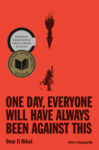
by Omar El Akkad, 2025
This is the “Fort Collins Reads” book for 2026, and our first Old Town Library book Club book on August 31st. It points out the hypocrisy of our nation in the face of the ongoing genocide in Gaza against the Palestinians. How many children are brutally murdered, how many innocent people are murdered daily – and the world excuses it, looks away, ignores it. He points out the hypocrisy of the liberal left. I hadn’t gotten that until I read this. There is so much anger at the Biden administration for siding with Israel, bankrolling the genocide, and its hypocrisy. They don’t care that Trump is so much worse. I still do not get that, but there it is.
He lives in Portland, Oregon. He has a precious daughter. The worst day of his life is when she had a respiratory illness and she couldn’t breathe. They took her to the hospital and sat by her bedside for 2 days until she was well. The worst day of his life. When so many Palestinian children have been brutally murdered, or seen their parents, grandparents, brutally murdered. Hospitals destroyed, food aid trucks prevented from entering, slow starvation of the people. And the world looks away. How long, O God, will the wicked prosper? Come, Lord Jesus, Come!
Pg. 80 writing about when he was a reporter and went to Guantanamo Bay – Gitmo: “Over and over, the justification for all this – the secrecy and the censorship and the treatment of prisoners outside the realm of what the country’s foundational legal principles would ever allow – is justified by the threat these prisoners are said to represent. In reality, the majority of them were never charged with anything, let alone convicted. Many of them the U.S. government freely admits were of no threat at all, wrongly imprisoned during the frenzy of those early War on Terror years.”
Pg. 81-82, again writing about Gitmo: “With relative (logistical, if not political) ease, pretty well every prisoner in Gitmo could all be transferred to facilities in the continental United States at any time, and the whole shameful legacy of the twenty-first century’s most notorious prison camp be ended. And yet every time the idea is floated, a slew of lawmakers raise hell about the dangers of letting the most dangerous, evil people on the planet anywhere near the homeland. Almost a quarter century in, most of the prisoners are elderly now, frail and suffering from so many injuries and illnesses that one of the storerooms in Camp 5, when we visited, was packed full of artificial legs – but that doesn’t matter. Whatever crimes they may have once been accused of, their mistreatment becomes, eventually, its own kind of self-perpetuating indictment. If they didn’t hate the West before decades of their lives were taken from them, mustn’t they hate it now? What is the statute of limitations on resentment, on rage, on revenge?”
Pg. 85-86: South Africa calls for charges of genocide: “Toward the end of December 2023, the South African government brings charges of genocide against Israel at the International Court of Justice. The case rests on Israel’s wholesale destruction of health facilities and the blocking of aid as evidence that what is being destroyed here isn’t a single terror organization, but a whole people.”…
“Second, there is the realization that of course it would be a country like South Africa that would take this step – a country deeply versed in the ugly mechanics of apartheid, for whose citizens checkpoints and forcefully sealed-off towns are not abstractions, but the very recent past that, from the safety of the present, everyone now claims they always opposed.”
Page 88 – ***Terrible thing happening to you: “No, there is no terrible thing coming for you in some distant future, but know that a terrible thing is happening to you now. You are being asked to kill off a part of you that would otherwise scream in opposition to injustice…”
He wrote a novel called American War, started it in 2014 and it was published in 2017. Hollywood was going to make it into a movie but they called it off in January 2024.
Pg. 91, the whole middle paragraph: “It’s almost refreshing, then, when one is faced with the ugliest and yet most honest face of Western apathy, the face that knows full well the scale and severity of the horror but believes it to be absolutely justified, absolutely necessary. I know this face, too. It appears on talk shows and atop opinion pieces stating, euphemistically or not, that the same world in which you can buy avocados all year round and your iPhone keeps getting more powerful and you never have to live in fear of an occupying force obliterating your family with missiles is the world in which an insignificant group of people you’ll never meet simply have to die. And whatever disgust this equation, laid bare, might inspire, many know it to be true. This is the world we’ve created, a world in which one privileged sliver consumes, insatiable, and the best everyone else can hope for is to not be consumed. It is not without reason that the most powerful nations on earth won’t intervene to stop a genocide but will happily bomb one of the poorest countries on the planet to keep a shipping lane open.”
Pg. 110-112, the Republican Party and the first election of Donald Trump:
“The main event sees a CNN moderator lob questions at nine Republican hopefuls, all of whom take turns doing the sort of thing Republicans have been doing for most of the twenty-first century, painting the United States as simultaneously the greatest country on earth and a nightmare place. An enormously powerful, God-chosen nation in which families are too scared to leave their houses at night. …
“Priebus, like most Republican Party insiders, hates Donald Trump…The glaring chasm between the dignified thing Republicanism pretends to be and the exclusively hate-catering thing it really is will soon stop being so glaring.
“Within a few months, most every one of these party insiders will roll over, pledge fealty to a man they privately despise…”
“…Even years later, as the same man, now convicted or indicted for a litany of crimes, still easily controls the base of the Republican Party, there is great care on the part of many mainstream liberals to focus on the destructive potential of Trump as a singular entity, a freak storm somehow returned to shore, rather than a symptom of an entirely different climate.”
Page 113, elect me or they will… “Among the more troubling trends of twenty-first-century American politics is the normalization of every election as the existential one, the one upon whose results rests the very survival of American democracy. In one way or another, there is some truth to this claim. Almost without fail, whatever deranged position sat on the periphery of the Republican Party a decade ago now resides in the center. Does anyone truly believe the same party, in another decade’s time, will be more moderate and reasonable? When will any Democratic candidate not be able to say: Elect me or they will dismantle everything, will wreak unimaginable havoc, unbelievable cruelty.”
Pg. 114-115, source of confusion, then rage: “It is a source of great confusion first, then growing rage, among establishment Democrats that there might exist a sizable group of people in this country who quite simply cannot condone a real, ongoing genocide, no matter how much worse an alternative ruling party may be or do. This stance boggles a particular kind of liberal mind because such a conception of political affairs, applied with any regularity, forces the establishment to stand for something…”
Page 119: “…Beyond self-interest, what do you believe in? And every morning the answer, dressed up in anesthetic euphemism and dependent on our collective capacity for resignation to the lesser of two evils, is: Nothing.”
“On January 26, 2024, the International Court of Justice rules that Israel must stand trial for genocide. Not long after, the United States, Canada, the United Kingdom, and six other nations decide to cut off all funding to the United Nations Relief and Works Agency, one of the few organizations providing any aid to Palestinians. The decision is supposedly based on allegations that about a dozen of the UNRWA’s 30,000 or so workers were involved in the October 7 Hamas attacks. The allegation is enough. Hundreds of millions of dollars are withheld. More people will starve to death because of this decision, taken in the halls of power far away from where the starvation will happen, taken by people who will never be held responsible for any of it, who will live out the rest of their lives in total comfort…”
Page 120-121: “A few days after the ICJ decision, Nancy Pelosi floats the theory that some of the people who are calling for a ceasefire have Russian ties. Later she’ll add China to the mix – the real source of this phantom treason of not much concern, in the grand scheme of things. … In the country of my birth, where, as of this writing, inflation rages somewhere around 130 percent and a substantial portion of the population doesn’t have enough to eat, everything is the fault of an insidious plot hatched by Israelis and Americans, by the West, by some outsider jealous of Egypt’s potential or intent on its destruction. It’s a prized tool in almost every failed regime’s workshop. It’s a source of great disillusionment, to see it so casually repurposed by a democratically elected Western politician.”
Page 124 – support no one: “Countless otherwise pragmatic people who would in any other circumstance choose liberalism by default will instead decide none of this is worth the damage to one’s soul. They will instead support no one, vote for no one, wash their hands of any ordering of the world that results in choices no better than this. And the obvious centrist refrain – But do you want the deranged right wing to win? – should, after even a moment of self-reflection, yield to a far more important question: How empty does your message have to be for a deranged right wing to even have a chance of winning? Of all the epitaphs that may one day be written on the gravestone of Western liberalism, the most damning is this: Faced off against a nihilistic, endlessly cruel manifestation of conservatism, and somehow managed to make it close.”
Page 125: “No, I don’t want a candidate who’s the embodiment of me. I want a candidate who doesn’t bankroll genocide.”
page 128, the “solid five:” “I start to keep a list of frequently asked questions at these events. The year before my novel was published, in an attempt to make friends in Portland, I’d signed up for a stand-up comedy class. Among the instructor’s most practical pieces of advice was to always have a solid five in your back pocket – a well-tested five-minute set of jokes you can always fall back on in a pinch. I begin creating my own solid five – answers to the questions I get most often.” [Apply this to Christianity, the problem of evil, etc.]
Page 143: “Where is the Palestinian Martin Luther King? I’ve heard said on more than one occasion, never accompanied by any self-reflection as to what kind of society necessitates a man like that, nor what that society ultimately did to him before his posthumous veneration. The implicit accusation is that certain people are incapable of responding to their mistreatment with grace, with patience, with love, and that this incapacity, not any external injustice, is responsible for the misery inflicted upon them.
“But Palestinians do respond overwhelmingly with love. Just as the Indigenous populations of an entire hemisphere, subjected to the largest genocide in human history, responded overwhelmingly with love. Just as the Black communities in much of the United States, a country that quite simply would not exist in its current form where it not for the theft of their labor, responded overwhelmingly with love. Just as every people everywhere deemed acceptable collateral in service of the empire’s interest responded overwhelmingly with love. Today I watched footage of a man kissing his son’s foot as he buried the body so torn apart by the missiles that the foot was one of the only pieces the father could find in the rubble. Tell me this man doesn’t know love, hasn’t been made to know it in a way no human being should.”
Page 148: “…Often, I watch discussions on social media in which someone asks: What radicalized you? In response, others will point to various moments of mass violence at the hands of the state, blatant cases of injustice, moments such as this one where it becomes clear there exists a massive gap between the empty statements of the powerful in support of justice and the application of actual justice. But the word “radicalize” feels wrong, seems to imply an element of extremism, as though rage at this kind of blatant hypocrisy is the abnormal thing, when what is plainly abnormal is to accept it.”
Page 151: “How does one finish the sentence: “It is unfortunate that tens of thousands of children are dead, but . . .”
“Ignore for a moment that the number is an approximation. Ignore the many more children mutilated, orphaned, left to scream under the rubble. Ignore the construction of the sentence itself, its dark similarities to the language of every abuser – You made me do this. Ignore all of these and think about how you would finish this sentence that has now been uttered in one form or another by so many otherwise deeply empathetic Western liberals. How to finish it and still be able to sleep at night.
“Surely, many people have, and their answers might relate to terrorists or revenge or an all-encompassing right to self-defense. But trimmed to its most basic language, every proposed conclusion to that sentence is some variant of the same basic thesis: They would have killed more of ours.
“What does unlimited fear cost? What will sate it?”
Page 160: “Daily we are told there is nothing better than this. Our graphics cards and loafers arrive at our doorsteps the same day we order them – what more is there to want? We hurtle from shock to shock, bubble to bubble, oriented in the direction of complete ecological collapse and a future mortgaged beyond any hope of repayment. Yet we are told the most frightening thing is not this building chaos, but rather the possibility that any other course might end in secret police and breadlines…”
Page 160-161: “In reality, what is happening is the opposite of an embrace. It’s a shoving aside of the present system, a system that makes it more and more clear there is no future, no community, for this or any other generation to come. Only endless taking – and if these young people must pay for it by forfeiting hope or possibility or clean air or a livable planet, so be it….”
Page 164 – gears will grind to a halt: “…The gears will grind to a halt one day, and the silence that waits then, for those who commended this killing and for those who said nothing, will be of a far more burrowing kind. It will take the form of grandchildren who, when the subject comes up, will pretend not to know how their grandparents behaved, will awkwardly try to talk about anything else…”
Page 164-165: “In late February 2024 I talk to a friend of mine, a Palestinian Canadian author whose debut novel, rejected by many publishers, seems to have finally found a home. He says he still doubts whether it’ll actually go out into the world. But he takes some solace in the likelihood that, by next year or the year after, it won’t just be Gaza that’s on fire, but the whole world, so what difference does it make what one book does? We laugh, but I can’t mount much of a counterargument. I know when an Arab says things like this, there’s a natural impulse to believe he’s talking about some great violent retribution, but I know what my friend means. A world that shrugs at one kind of slaughter has developed a terrible immunity. No atrocity is too great to shrug away now, the muscles of indifference having been sufficiently conditioned….”
Page 165: “Even walking away sometimes feels no more or less hollow than any other pragmatic solution to what should never have been a pragmatic issue. That it might work – as it did, finally, after the economic ostracization of apartheid South Africa – only reinforces that there was never any morality amount those atop the empire’s food chain, only a greed momentarily exploited. In the midst of the world’s first livestreamed genocide, when plain before the eyes of anyone who cares to look are shown the most visceral details, one of the few things that inspires any real panic on the part of most Western power centers is the prospect of reduced shipping activity through the Red Sea…”
Page 166: “…What is the ethical legitimacy of any system in which one has to hope the most privileged sliver of global society decides, in large enough numbers, that a sufficient number of children have been murdered to warrant choosing a different brand of couscous? That enough migrants have been caged or drowned to make a particular vacation spot unappealing? That the well-being of Congolese children outranks the desire for ever more powerful smartphones?
“Active resistance – showing up to protests and speaking out and working to make change even at the smallest levels, the school boards and town councils – matters. Negative resistance – refusing to participate when the act of participation falls below one’s moral threshold – matters. And yet there are days when both negative and active resistance feel pointless. A political system that won’t restrict firearms even after a shooter massacres classrooms full of children, a system that shrugs when a regime murders and dismembers a journalist because that regime controls an inordinate amount of oil, a system that won’t flinch at the images of starving babies when it has the power to save their lives – what manner of resistance can’t such a system learn to abide? What use is any of it, what use?”
Page 177-178 – our ever-growing tolerance for calamity: “Whatever late capitalism is, it seems to be careening into this embrace of growth by negation. Through that prism, it’s hard not to see the advances in something like artificial intelligence less driven by technological breakthroughs as by a society that has, over years, over decades, become normalized to a greater and greater magnitude of both loneliness and theft, such that a sputtering algorithm badly trained on the stolen work of real human beings might be celebrated with a straight face as something approximating humanness…
“Unconfronted, this kind of negation will not remain confined to widgets or labor or even the economic world. When the bigger wildfires come – as they already have – the industries whose callous disregard helped bring this about will depend on our ever-growing tolerance for calamity. When climate change upends the lives of billions, our governments will depend on our ever-growing tolerance for violence against the hordes of nameless others to enact its cruelest, most violent fortressing. In time, negation becomes all there is. To walk away from this system is to speak the only language the system will ever understand.
“Otherwise, there will be nothing left under this way of living…”
Pg 181 – “On the worst night of my life, my daughter woke up coughing. She was one and a half years old at the time….She woke up in the middle of the night, and in the way these kinds of parental instincts so often kick in, we decided right away to take her to the emergency room.
“For the next two days, we sat by her bedside…It remains, to this day, the most scared I’ve even been…”
Pg 182: “It is a disorienting thing, to keep a ledger of atrocity, to write the ugliness of each day as it happens. The months smother the months, soon the years will smother the years. Killings that might have once made front-page news slowly submit to the law of diminishing returns – what is left to say but more dead, more dead?…Maybe this is the truly weightless time, after the front page loses interest but before the history books arrive.”
Page 184: “One day it will become impossible to accept the assurances of the same moderates who say with great conviction: Yes the air has turned sour and yes the storms have grown beyond categorization and yes the fires and the floods have made of life a wild careen from one disaster to the next and yes millions die from the heat alone and entire species are swept into extinction daily and the colonized are driven from their land and the refugees die in droves on the borders of the unsated side of the planet and yes supply chains are beginning to come apart and yes soon enough it’ll come to our doorstep, even our doorstep in this last coddled bastion of the very civilized world, when one day we turn on the tap and nothing comes out and we visit the grocery store and the shelves are empty and we must finally face the reality of it as billions before us have been made to face the reality of it but until then, until that very last moment, it’s important to understand that this really is the best way of doing things.”
Pg 185: “…Far enough gone, the systemic murder of a people will become safe enough to fit on a lawn sign. There’s always room on a liberal’s lawn.”
Wayne says: “War Pigs. And it becomes doubly bad when done in the name of Christianity.”