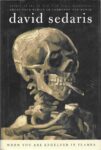
by David Sedaris, 2008
Hilarious book! I laughed out loud on almost every page! I got this from a Little Free Library, either the one on Locust Street or the one on Smith Street. I’d heard about him from bestseller’s lists for years, so glad I got to finally read him. He is so funny! He’s 2 years older than Wayne and I, so that makes him familiar. But, he grew up in Raleigh, North Carolina, and that’s worlds away from our childhoods.
It’s chapter after chapter of parts of his life that he makes so funny. He’s gay, and his partner is Hugh. Hugh has long legs and David cannot keep up with him. He describes being lost in Australia and full of rage at Hugh, thinking all sorts of terrible things, ending it, leaving him, etc. When he finally finds Hugh and Hugh asks him where he’s been, all of the anger and rage disappear and he just says, I was lost.
Some of the stories are kind of gross – like the white trash baby-sitter they had once when he was a child. She and her ilk make one dislike the south even more. But she takes them to her trailer and it’s full of baby dolls arranged just so, very neat and tidy. And when their Mom and Dad get home and they are trying to tell their Mom how terrible she was, Mom goes in and starts talking with her like they are old friends.
One of my favorite stories is the one about April, the spider. He and Hugh are living in Normandy in an old house, and there are spiders everywhere. Once he caught a fly and a big spider nabbed it. He decided to start feeding the spider and went around catching flies. He named her April. When they went to Paris for a vacation, he took April along and tried to find flies for her in Paris, but there weren’t any. When they returned to Normandy, he brought her back and released her into her old home but she took off and he never saw her again.
Lots of fun reading – laugh out loud funny!
Here’s some favorites:
Pg. 182 – what hell must be like, his neighbors in Normandy are keeping two grown magpies in a cage: “Being locked up is one thing, but to have no concept of confinement, to be ignorant of its terms and never understand that struggle is useless – that’s what hell must be like.” This chapter is about birds in Normandy that keep dashing themselves against their windows. He puts up pictures, album covers with faces on them, in every window. That solves it.
Pg. 195: Of Mice and Men: “I’ve always admired people who can enter a conversation without overtaking it. My friend Evelyn, for instance, “Hello, so nice to meet you,” and then she just accepts things as they come. If her new acquaintance wants to talk about plants, she might mention a few of her own, never boastfully, but with a pleasant tone of surprise, as if her parlor palm and the other person’s had coincidentally attended the same high school. The secret to her social success is that she’s genuinely interested – not in all subjects, maybe, but definitely in all people.”
Pg. 217 – 227, Cry Baby, this entire chapter is so funny. It’s about being in Business Elite class on a nighttime flight to Paris and one of the passengers, a Polish man, has just lost his mother, and won’t stop crying. The stewardess kneels down to David and asks him ever so gently, if it would be okay for the crying man to sit next to him – he’s bothering the people he’s next to right now.
“Then a flight attendant knelt in the aisle beside my seat and asked if I might do her a favor. That’s how they talk in Business Elite. “I’m wondering, Mr. Sedaris, if you might do me a favor?”
“Chipmunk-like, my cheeks packed with warm nuts, I cocked my head.”
So, the crying Polish man sits next to David and it’s just one hilarious thought and action after another, until David is sitting there next to him crying like a baby, too. What he finally remembered that got him crying was his Greek grandmother’s flatulence that caused he and his 5 siblings to crack up, and his father taking a spoon to beat them for laughing, and that causing them to laugh even harder, and him realizing that was 40 years ago. “Could that really have been forty years ago? The thought of my sisters and me, so young then, and so untroubled, was sobering, and within a minute, Chris Rock or no Chris Rock, I was the one crying on the night flight to Paris. It wasn’t my intention to steal anyone’s thunder. A minute or two was all I needed. But in the meantime here we were: two grown men in roomy seats, each blubbering in his own elite puddle of light.”
The book ends with a very, very long chapter called The Smoking Section, of how he quits smoking. He tells how his Mom is dying of cancer from smoking and she gives David a carton of Kool Milds on her death bed. He describes how smoking was everywhere and then, place by place, it began to be forbidden, until the smokers were banished to the dregs – the way he describes these places is just so depressing and disgusting, but funny. So, he decides he must quit. On his quit day, he and Hugh fly to Japan for a 3-month vacation. Change everything to keep his mind off of cigarettes. That’s where the title of the book comes from. Page 309, he’s describing funny English signs in Japan: “A booklet in our hotel room includes a section on safety awkwardly titled Best Knowledge of Disaster Damage Prevention and Favors to Ask of You. What follows are three paragraphs, each written beneath a separate, boldfaced heading: “When you check in the hotel room,” “When you find a fire,” and, my favorite, “When you are engulfed in flames.”
Page 320 and 321, he and Hugh are in Thailand, and David’s just been arrested for littering – he dropped his cigarette butt and crushed it. “When the officers returned, they handed me a pen and placed a sheet of paper before me. The document was in Thai, a language that looks like cake decoration to me.” He stopped littering cigarette butts from that point on. Then, he remembers his Greek grandmother, riding in the back seat of their station wagon, and throwing trash out the window. “Yiayia lived with us while I was growing up and was hands down the worst litterbug I had ever seen. Cans, bottles, fat Sunday newspapers, anything that could fit through the car window was thrown through the car window. “What the hell are you doing?” my father would shout. “Throwing crap onto the road, we don’t do that in this country.”
“Yiayia would blink at him through her thick-lensed glasses. Then she’d say, “Oh,” and do it again two minutes later, this as if the grocery receipt was litter but the Time magazine wasn’t. I think she actually saved her used tissues and empty medicine bottles, stuck them in her purse until she was back in the moving station wagon…”
“During the period that our grandmother lived with us, litter was very much on our minds, in part the result of TV. The “Keep America Beautiful” commercials featured a crying Indian, his composure shattered by the sight of a trash-strewn creek bed.”
Last few paragraphs describe how he stopped crushing cigarette butts underfoot after being arrested for it in Bangkok – from then on, he always tried to find a trash can, or carried it in the cuff of his pants until he got home. Now that he has quit, he has started collecting trash – picking up trash on the ground, but never cigarette butts. “… it’s funny, but the only thing I won’t pick up are discarded butts. It’s not their germs that put me off. I’m simply afraid that on taking one between my fingers, I’ll somehow snap to and remember, with clarity, just how good a cigarette would taste right now.” That is the last sentence of the book.
I googled him and he does pick up trash around their town of Rackham, West Sussex, England, so much that they call him “Pig Pen,” and a waste vehicle has been named after him.
From Wikipedia: “In 2013, he purchased a beach house on Emerald Isle, North Carolina; many of the stories in his 2018 collection Calypso are set there. Sedaris currently divides his time between Rackham, West Sussex, England, and New York City. Sedaris told a 2025 audience in Sydney, Australia that he had qualified for British citizenship in 2023 but had not had time to get a passport.
Sedaris is known for regularly spending hours removing litter from roads and highways near Rackham. His hobby has earned him the nickname of “Pig Pen” locally, and a waste vehicle has been named after him.”
There is a darkness to some of his writing, though, and you can tell he is not a fan of the God that has been communicated to us from the Christian nationalists the last 50 years. He belittles an 8 or 9 year-old boy who quizzes him about God, after David beats this little boy at lap-swimming. Pages 316-318. The little boy asks him if he believes in God and David says No..Why not? … because I have back hair…God touched you and that’s how you won… Why would God touch me and not you?… You’re going to hell. David thanks him for the tip. He compares this little boy’s haircut and eyes to Hitler. The idea is that Christians are dumb and God is mean and vindictive. So, my prayer for David is that he would “grasp how wide and long and high and deep is the love of Christ, and to know this love that surpasses knowledge…”