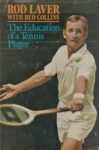
by Rodney G. Laver with Bud Collins, 1971
Fun and interesting book. Wayne’s tennis buddy, Mike G., let Wayne read the copy Mike got from his parents as a gift when he was a teenager. I got mine from the library so I wouldn’t ruin Mike’s copy by spilling something on it.
Wayne’s tips after reading this book:
“Advice from Rod Laver’s 1971 autobiography…
Very successful guy with a wood racket, small stature, and common sense outlook.
On Match Play:
There is no chance to win the point until the ball is on the other side of the net.
This point is the only one that matters; the last one is done, gone.
More points are won or lost on errors than on clean winners. This does not mean being a pusher –
be aggressive, just don’t overhit, dial it back enough to make sure you get it.
The better you watch the ball, the better chance you have of making your shot.
(And keeping pressure at bay.)
Use your best shots, the ones you own 100% …
So much better than giving them the point via trying shots you don’t have. Surprise is way over-rated.
Killer instinct goes for 6-0 6-0. It is sure (big targets) with the ducks, not wild.
Focus extra hard on getting the first point of every game.
Fatigue brings more unforced errors… plan for it by choosing shots with more margin for error in the second set.
Overheads and serves are fatiguing. Lob old guys. Get your first serve in, at 80% if necessary.
Do what is necessary to avoid thinking about a match before stepping on the court. 10 minutes of practice sometime earlier in the day is a big plus.
On How To:
Getting Older: Play no ad. Use a lighter racket. Don’t go after balls that you don’t have a good play on. Warm up. Electrolytes beforehand. Go slow, easy, and plenty with practice serves.
Play 100% three days/wk, 40% the other three, rest one. Walk daily.
Serve and Return: his toss is straight overhead, not left, and not very far right unless slicing.
Going wide makes your opponent run to get in position for the next shot.
Missed returns on second serves are in fact unforced errors.
Volley… Think short, quick, stiff jab. Eye on it all the way.
Hand always below the level of the ball. Volley with your feet to increase power and depth.
Wrapping it up: Watching the ball, from his strings to yours. Not the opponent, not the court.
Do this and all else will follow, far and away the main thing. Related – “play the ball, not the opponent.” (Second is bending your knees to make a better shot. Third is to get that first serve in.)” Excellent summary, Wayne!
This is the story of Rod Laver’s Grand Slam year in 1969, starting in Australia and ending in the U.S. The Open era of tennis had just begun. He was a professional tennis player and they were not allowed to play in many of the tournaments because of that. In 1968, that changed with Wimbledon, which became “open” to the professionals along with the amateurs. Rod Laver won all the slams in 1969, the same year his wife Mary was pregnant and due to give birth while he was in New York for the U.S. Open. She was late and it’s a good thing, because he went all the way to the final and won. He won $16,000. He won the first Open Grand Slam in tennis history.
He was born in Australia on a cattle ranch on August 9, 1938. He’s as old as Mom. I’ve seen him in the stands of many, many tournaments. He watches quietly and intently and the camera goes to his face often. Roger Federer named the Laver Cup after him. His wife, Mary, the love of his life, died in 2012. She was an American, 10 years older than him. She died at 84, Rod was 74. They only had the one son, Rick Laver, born the year of his 1969 Grand Slam, but Mary had 3 children from a prior marriage. Rod was considered the best player of the time. He is small, only weighed 147 pounds. He is left-handed.
The book takes you tournament-by-tournament through his 1969 Grand Slam year, starting in Australia and ending in the U.S. After each tournament, there are short tennis lessons, 25 of them, that cover just about everything a tennis player needs to know about competition.
Wayne says the funny parts of this book, and there are quite a few, are Bud Collins, who Rod thanks in the Acknowledgements: “Bud Collins, who yanked the whole story out of me, and who suffers as much as I do when I lose. (After all, he shares in the royalties from this book.)”
He dedicates the book to his wife, Mary: “For Mary, who made it the grandest Slam”
Here are parts that struck me:
page 14: “Because you need help. Yes, you-standing there with your racket dragging. You aren’t keeping your eye on the ball for one thing. I know because when I watch movies of myself I notice that I’m guilty of that sin. If I’m caught with wandering eyes-and not only when there’s a blonde in the first row-I’ll assume that you are, too.”
Page 35 in the chapter called Something Called the Grand Slam, describing 1938, Jack Crawford playing Fred Perry at Forest Hills for the U.S. Championship, and a Grand Slam: “With his 2-1 lead in sets Crawford may have looked the winner, but he was through, exhausted. He was having trouble with his asthma, and even occasional slugs of brandy taken during the fourth and fifth sets couldn’t turn him back on. Jack won one more game, and Perry won the match.”
Page 79-80, chapter 5, The First Leg of the Slam: The Australian, he’s writing about Roy Emerson, fellow Australian who also grew up on a cattle ranch. He calls him Emmo. “Emmo has a very rigid code for himself, and we like to think this is the way of a dinkum (honest-to-God) Aussie. Although he has had numerous injuries during his career, one of them costing him his fourth Wimbledon title and the other possibly costing him a fifth-and making it easier on my Slam in 962-he never, never talks about them or implies that an injury was the cause for defeat.”
“…Any talk of injury, as an excuse, grates on Emmo.”
Page 83, playing in 105 degree heat in Brisbane, playing Tony Roche, a fellow lefty Australian. Tony got the 3rd set: “That brought merciful intermission with a shower in the dressing room, one of those showers you never want to leave.”
Page 85, same chapter, same excruciatingly hot match in Brisbane against Tony Roche: “The wet towels from the icebox felt good on my head. I wrung out my sun hat and it was like squeezing a sponge. One of the things I used to do on hot days was put a piece of wet cabbage inside my hat. That was a pretty good trick for keeping cool…
“It was his turn to serve and I screwed my mind into working for every point as though it were the last. If you do that when you come down the stretch in a tight match you’ll be surprised how often a superhuman effort will come out of you. “It’s 3-4 in the last set, and I’m going to hack and grub,” I told myself. “Just do anything to get the ball over the net. It doesn’t matter how you look. Form won’t win this one.””
Lesson 5, Confidence and Shrugging Off Bad Luck
“Amnesia, that’s what a tennis player needs. Well, maybe not quite a total loss of memory, but I can’t stress too much the importance of shoving the last point right out of your mind. Forget it. A point won’t come back no matter how much you think about it. If you played it badly there’s no way you can reverse it; if you played it well, it won’t help you on the next point.”
Page 94, he has tennis elbow really bad: “I had a long time to wonder and worry, a flight from New York to Johannesburg. Would the elbow be any good for anything but bartending? I’ve known Australian bartenders who got tennis elbow from working too hard during the maelstrom of the Six O’clock Swill–those last desperate minutes before closing time.”
I googled the Six O’Clock Swill: Yes, bars used to close at 6 p.m. and so the drinkers had only an hour from the time they got off work until closing time. It started in WWI in Australia and New Zealand as an austerity and temperance measure but kept on going until the 1960’s. Bartenders used to line up the drinks, pouring one after another. It led to some bad outcomes, this binge drinking, but it took a long time to end it.
Chapter 7 is called South Africa. Tennis in South Africa was a big deal. There were tournaments there, but apartheid killed it. They wouldn’t let Arthur Ashe play there. “Johannesburg is comparable to London during Wimbledon: everybody is aware of the tournament and the players, and wants to go watch the tennis.
“Well, maybe not everybody. The blacks, of course, are not part of the mainstream, and it is their exclusion-the policy of apartheid-which may lead to the breakdown of this tournament as one of the world’s best.”
Page 99, he’s talking about Pancho Gonzales: “Although I was the winner, a guy named Gonzales stole the show from me as he has so many times….
“Without Pancho you guys would be out of business.” We heard that over and over, and it cheesed us off….
“This bothered us, and so did Pancho’s attitude in the mid-1960s. He was ungracious to say the least, a loner, and an absolute jerk on the court….”
Lesson 7 Changing Your Game as You Grow Older
Jack Kramer quote: “The first thing that goes in an aging tennis player is not his legs-but his overhead.”
“…The overhead is the most tiring stroke to hit, and if you can make older opponents hit a lot of them, you’re going to cause a breakdown.”
Other hints for aging players: Use a lighter racket (Pancho switched to a metal racket.) “On the serve it’s doubly important for the older player to get the first ball in, for this is a fatiguing stroke, too, and you want to hit as few serves as possible.”
“….he must play more thoughtfully, mixing up his strokes, hitting the ball on the rise to take advantage of the pace his opponent put on the ball and using less energy of his own. He won’t run for a ball that is obviously out of reach, or on a point that probably doesn’t mean much, say at 40-0 or 0-40.
“Gonzales is a good example. He musters his energy, saving the big serve for when he really needs it. He keeps his returns low and soft, and uses the lob often and well. When he does come to the net he makes sure it’s behind a worthwhile shot. He feels that his eyes and reflexes have gone just a little and has trouble with balls hit directly at him at net. This is always a good tactic to use with a volleyer-bang it right at him-and it pays off more against an older opponent.
“Older players are more likely to pull muscles, so they should be sure to be warmed up properly, and should take it easy if they haven’t been playing regularly.”
Chapter 8, The Davis Cup Jitters, page 104-105: “A few Australians have made fools of themselves with temper displays and have been caught with their sportsmanship down. Very few. That doesn’t mean that Australia doesn’t breed racket-throwers and whiners. It’s just that those types don’t get sent away….
“We’re an easygoing people, but we’re very competitive, too, somehow different from the Americans whom we consider our best friends and hottest rivals. Australians have handled the pressure of tight situations in tennis better than Americans. We don’t blow up. That’s not 100 percent true but it does seem that way, and when our players collapse or choke they don’t rave and fume like Americans. I think it’s because of the difference in the societies. We’re competitive in sports all right, as much as anybody in the world, but the Americans are competitive in everything, every waking minute.
“The pressures are much greater on American tennis players, and it’s no wonder they explode….
“There’s no stigma attached to leaving school at that age in Australia [fifteen].” He’s talking about the American players not being able to concentrate solely on tennis – they all have so many competing expectations; namely, completing high school and going to college, and that is why there aren’t champion Americans. He actually quit school at 14 because he had hepatitis and his Dad took him away and let him heal for a year. He never went back to school.
Page 108: “I settled into my career young, and I think that helped my temperament. I knew what I was doing; I was beginning my adult role at fifteen. The American kid is bewildered about what he wants to do then, and he’s got so many options.”
Lesson 8, Pressure: “…But if the situation is tense, chances are the tension is on both sides of the net, and if you can keep hustling and putting balls back, you’ll be piling the pressure up on your rival.
“Scrambling and running have won more matches than great shot-making.
“Determination has a lot to do with dispelling pressure. You’ve got to go onto the court thinking you’re going to win. Be positive. Screw in your concentration. …
“In concentrating you have to wipe everything out of your mind but the match, particularly the ball. Nothing but the ball. Glue your eyes on it. Marry it. …”
Lesson 9, Don’t Change a Winning Game (and Always Change a Losing Game) “Often you can size up your opponent in the warm-up. Give him a variety of shots and see how he handles them. You may be able to discover weaknesses right away.”
“There are a couple of tactics you never want to change. Always go hard for the first point of a game and the first two games of a set. I don’t mean you can coast if you win them, but getting in those first licks can frequently strike a big psychological blow.”
Page 160, in the chapter called Doubles: “You should have a “think-nothing-of-it-old-pal” air about you when your accomplice flubs a routine overhead on the big point. It isn’t going to help your mood, his confidence, or the team’s chances if you act injured by his mistakes. Compatibility and cool are the essence.”
“…Teamwork and consistency win doubles matches. When your partner lunges in front of you to pounce for the kill, your move is to fill the hole he vacated.
“If you can keep the ball low, your opponents will have to hit up to you, and you’ll be able to put away a lot of balls. That’s what you’re after, ideally, the chance to murder a shoulder-high volley.
“Until you have that opening, concentrate throughout on The Guiding Principle: keep the ball in play, avoiding temptation to overpower. Any ball hit over the net with care is worth two blasts that may well land in the bush.”
Chapter 14: Paradise Regained – Wimbledon
“But Wimbledon stood for the best, and insisted on being the best in more than name. Only the prestige of Wimbledon could break the status quo and force open tennis into existence in 1968.”
Page 174, playing in wind: “Use more spin so you can control the ball, and a lower toss on serve so that the ball doesn’t blow off course unnecessarily…Test your shots carefully before the match starts, and on a tricky windy day warm up from both sides of the court.”
“…Conditions are the same for you and your opponent. He’s bothered, too.
“Act like you love it….
“You can drive an opponent crazy by refusing to let anything bother you when obviously the situation is a mess.”
Serving in pictures: Concentrate on getting the first serve over the net. Take your time. Serving is the only stroke where you have the time to think the whole stroke through. “Do it unrushed in your own good sweet time.” (And watch the ball all the way to impact.
Forehand in pictures, page 183: “No rest for the wicked character across the net who wants to beat me. That’s my philosophy, and it’s why I hit the ball on the rise so he’ll have less chance to get himself ready.”
Volleying in pictures, page 191: “Just remember there’s hardly any backswing-that’s one of my problems-and you try to keep your wrist lower than the head of the racket, no matter how low the volley. Keep the racket out in front of you and punch briskly. There isn’t much follow-through, but don’t let the racket head drop once you’ve connected. If you lock your eye onto that ball all the way, volleying should be easier than anything else.”
Page 201, in chapter 15, Respectability is a Club Tie, he talks about how if you became a professional tennis player, the officials at Wimbledon wrote to you and told you you could no longer where your Wimbledon tie and you were stripped of your membership. Because of the work of a man from New Orleans, Dave Dixon, tennis rules changed and Wimbledon was the first slam to become open, allowing the professionals to compete once again. Dave Dixon was chairman of a proposed dome stadium in New Orleans and was looking for ways to keep it filled year-round and came across the game of tennis. He got hooked on tennis and became an avid promoter of the game. He and Lamar Hunt started World Championship Tennis and because of that competition with the National Tennis League and the International Professional Tennis Association, there weren’t many amateurs left in the game, so they had to open the tournaments to professionals.
Lesson 15 “Court Manners and Etiquette”
When subject to a bad call: “Once we had registered disapproval and asked the linesman to reconsider (they can change their calls, you know), we brushed that point out of our minds. On to the next point.”
Page 206: “If you suspect someone of giving you the business consistently on bad calls, you can refuse to play him again. Or break his rackets over your knee. I never resort to the latter because I weigh only 147, and hardly anybody I play with is smaller.”
Page 211-212 talking about the fashion of Wimbledon: “Of all the extraordinary female costumes at Wimbledon, the most direct and beguiling was that worn by an American model Pat Stewart in 1959. Her panties were not gold lame, like the ones belonging to Karol Fageros that were prudishly ruled off in 1958 by Wimbledon officials. Nor were they as lace as the famed underwear of Gussie Moran.
“On Pat’s cotton bottom was embroidered her phone number, revealed every time she served. It was there until her fiance found out and objected.
“Pat, who modeled girdles when she wasn’t playing, seems to have the right outlook…”
Page 214, A Shaky Beginning, he is down 2 sets to love to an Indian player, Premjit Lall, to whom he had never lost. “There wasn’t any crispness in my volleys, and I tend to get more nervous in a match that I’m supposed to win easily. I think anybody does. You get behind and you try to make up the points too fast. This is when you should slow yourself down, and try to think about a few essentials. Watch the ball. Make sure your serve toss is high enough. Don’t get helter-skelter. The pressure is all on you, but if you can just slow down-like a basketball team taking time out-then maybe you can win a few points and get the pressure shifted to the other fellow.”
Chapter 17, A Man Named Gonzales
“He is still capable of calling a linesman an idiot, or irresponsibly pitching his racket so that it could split a bystander’s skull, of trying to strangle a photographer whose clicking irks him.
“Gonzales is the master gamesman, a badgerer and moaner. Yet his legs have stayed stronger than the vitriol content in his system…”
Page 220-221: “In 1963, trying to put some semblance of order in the professional game, we players formed an organization called the IPTA-International Professional Tennis Association. We made a rule that nobody could play the tournaments unless he was a member. It seemed reasonable to us, and Pancho was the only one who refused to join. Pancho always goes his own way. He insisted we had to let him play any time he wanted, and we refused.
“Suddenly I was subpoenaed. So were Buchholz, Rosewall, Gimeno, and the others. Pancho was suing us for $250,000 for violation of antitrust laws. I’d never heard of antitrust. My respect for Pancho dropped to nil, although it didn’t have far to drop. Here he was, slapping a suit on somebody trying to form a sound organization to help the game.
“Maybe he was right, in a way, saying that we shouldn’t keep him out of tournaments. But the point was it wouldn’t have costs him much to oin, and it was a time when pro tennis players needed solidarity to accomplish anything. They still do, but the situation isn’t as precarious.
“There I was in the wrong kind of court…When I now think of pressure in court, it’s that trial-not Wimbledon. It took two days and cost us $7000 in legal fees. We didn’t have to pay Pancho any money, but he won, getting the right to negotiate his own deals with any tournament.”
page 222: “It has been a Gonzales characteristic that when he got mad he played better. If something bothered him and he began to rage-look out. This is unusual. Almost invariably the man who loses his temper loses his composure, his concentration, and his game crumbles. Not Pancho.
“I hardly ever lose my temper, and almost never in a match. Nobody would put up with that sort of thing when I was a boy in Australia. Neither Charlie Hollis nor my folds would stand for any outbursts, which they considered poor sportsmanship. They also taught me that a show of temper is a great help to your opponent because it lets him know that you’re disturbed and our confidence is letting down. That’s generally true, except with Pancho.
“Pancho would like you to lose your temper. He wants to break down your concentration with his own fuming and fussing. That’s what a lot of it is about. Most of us are used to it now, and we accept it as part of the game. We still don’t like it because no matter how ready we are for an explosion, we’re apprehensive that the delay and his mad scene will pierce our concentration. That’s the danger. While Pancho is screaming at a linesman or threatening to punch a spectator who’s made a noise, you’re standing there trying to put it all out of your mind, hoping your rhythm hasn’t been destroyed. Another reason for his fuming is to stall and gain a time-out for himself to rest. (Everybody has stalled at one time or another, though few as theatrically as Pancho. My method of taking a break is to “accidentally” step on one of my shoes in such a way that it comes off. Then I have a few moments to make necessary adjustments.)
Page 228 in Chapter 18, A Few Words from Mary Laver
“Sometimes when I question what I’m doing, spending my life chasing a little white ball around-wondering if there’s really any point to it-I feel better thinking of Jerry. I suppose at one time or another everybody has doubts about his occupation being worthwhile and his contributions to mankind.
“Jerry scoffs at that. “Why, the pleasure you give people who watch is immeasurable. You can’t imagine the service you render through entertainment. You do wonders for me, not to mention the young you inspire to take up this healthful game.”
“I like that.” (He’s talking about a huge fan of the game, a Bostonian named Jerome Scheuer, an old friend of his.)
Same chapter, his wife Mary says on page 230:
“It’s always amazed me how loose and easygoing he is, particularly when the pressure builds. I thought he might show nerves a bit in 1968, the first time back at Wimbledon, and he had every reason to with all that went wrong. He had the bad wrist – eventually developing into the bad elbow – and halfway through the tournament his right foot became infected, the infection spreading up the leg.
“Nobody knew. That’s the Aussie code – never let on. He was strapping his wrist before every match, but never in the dressing room where the word would get around. It wasn’t only the show-must-go-on bit. He didn’t want to give anybody he played a lift from knowing he wasn’t completely right.
“So just before he was to play we’d go to a phone booth on the grounds and crowd inside while I wrapped the wrist…”
“The foot problem came from a blister. We were lucky that Dr. Norm Rudy, a friend from Los Angeles, was staying at the Dolphin Square, too. He came to our room in the middle of the night, lanced the blister and took care of everything. Rod was playing the next day.”
Same chapter, Page 233: “Rod was really excited about becoming a father. He wanted a boy and got what he wanted: Rick Rodney Laver. He thinks Paris was the hardest work of the Slam year-but that’s only because he wasn’t the one who had Rick.
“He delivered the Slam, and I delivered the heir. Neither of us could have improved on our performances and we didn’t try. Rod decided not to enter the Australian Open in 1970 because the money was so low. One night he said, ‘Guess I won’t be trying for a repeat this year, Mary.’
“‘Well, dear, neither will I,’ I replied.
“We didn’t want to be ostentatious.”
Lesson 19, The Backhand and Topspin
“One of the great mental blocks in tennis that shouldn’t be there is the backhand….
“Why should it be? It’s the most natural shot there is – just letting your arm roll out to its full length. Try to think of it that way: unwinding.”
“But I think you should experiment with your game. If you think you can topspin a ball-try it. If you want to really hit the ball hard on the backhand, you’ll have to consider topspin. It’s the only way, then.
“At any level of play you have to get that lead shoulder all the way around – right shoulder for a right-hander. Get the shoulder around, hit the ball in front of the front foot, and let your arm unwind, and you’ve got it.”
Chapter 20: Three Down and One To Go
“The impact of Arthur Ashe on tennis is incredible. Probably the best thing that happened to the game in 1968 was that I didn’t win the U.S. Open at Forest Hills and he did.
“He had the right combination to make the world, especially America, notice: He was black, he was American, he was exciting – a big hitter – he was articulate and he knew his way around…”
“It was, and is, an awesome role. Sometimes Arthur seems to act as though the world is on his shoulders. But the fact is that pressures on him from all sides must be terrific. I can’t imagine how it would be to walk in his shoes…”
Lesson 20, Returning Serve
“Make up your mind on this: you’re going to get that serve back over the net. Consistent returning puts pressure on the server. Usually you’ll just block the first serve, since your opponent will probably have some pace on the ball…
“Even a broken-down-looking return gives the server a problem. Once you’ve put the ball over the net you’ve got an even chance of winning the point. Try to keep the ball low, especially against an opponent who follows his serve to the net. Use a lob occasionally against a net rusher. It will startle him.
“Don’t over hit. Nothing picks up your opponent more than ripping returns of serve – that slap harmlessly into the net.
“Get that return over the net. Any way. Or go stand in the corner.”
Chapter 21, The Spoils of Victory
He writes about getting an agent, finally, in 1968. He tried in 1966 before tennis was open and no one bit. But in 1968, when tennis went open, he tried again, and landed an agent, who got him sponsorships and his income took off.
“A bright example of how things changed was shoes. I had signed in 1966 with a small New England manufacturer who produced a line of Rod Laver tennis shoes. My deal was $1,000 plus 2.5 percent of royalties. It was a bad deal and the shoe was inadequately promoted. I was getting royalty checks periodically for $7.80 or $25 – figures like that. Beer money. When that contract was up, McCormack placed me with the German firm Adidas, an arrangement that meant many times more.”
Chapter 22, The Beginning of the End
“There were a couple of vital things I learned from the 19652 ordeal. Censor your newspaper reading. Stay in a quiet, secluded place during the tournament.
“Billie Jean King’s dad, Bill Moffitt, once gave her the best advice an athlete can get: “Don’t read anything that’s written about you,” he told her. “It will be either overly complimentary or overly critical, and neither will do you any good.”…
“You have to talk to reporters. I like most of them, and they’ve been good to me. But you don’t have to read what they write. They’re all looking for a different angle, and that angle could spoil your digestion or your sleep.”
…
“Chuck Heston was very helpful. Chuck, who has impersonated Moses, Michelangelo, Andrew Jackson, Ben Hur – and also does a good impersonation of a tennis player when he can escape filming – loaned me his Manhattan apartment on the East River….”
“We moved into Heston’s spacious, high-ceilinged penthouse with a tape recorder for musical company, a supply of eggs and steak, and settled into a quiet routine, spending as little time as possible at the West Side Club, then only to play or practice. Unlike Wimbledon, there’s no privacy for the players, no place to relax away from the press or the crowds. At one time I imagine Forest Hills was a very pleasant place, well out from Manhattan, an enclave of its own. Now Queens is crowded, unattractive. The club is hard to get to through the traffic; parking is impossible. It always amazes me how the English, jammed into that little island, have managed to preserve their greenery so that Wimbledon is such a countrified place within a huge city, while Queens has become a depressing jumble.
“Financially the U.S. Open is No. 1. Prize money at Forest Hills added up to $137,000 in 1969, with $16,000 for the winner of the men’s singles. In prestige, it’s No. 2, behind Wimbledon. But in playing conditions, it’s a far-down bush league all its own. The courts are grass, and American grass is for cows and lovers – not tennis players. In fact, American grass courts are so uncertain underfoot that an unwary cow might break a leg strolling from baseline to net. Or starve. There isn’t much grass left on an American court by the time a tournament reaches its climax….”
“You adapt. The game I play at Forest Hills – or on any other American grass – is entirely different from how I play on Wimbledon’s firm and true grass. Junk brings results at Forest Hills….”
Lesson 22, Know Yourself
“You win tennis matches on the other guy’s errors and by keeping the ball going. You’re just aiding and abetting the enemy by trying to pull off the impractical or impossible shot in certain situations.”
Chapter 23, The Last Leg of the Slam: Forest Hills
He’s playing an American, Dennis Ralston, and the crowd cheers for him every time he walks back onto the court after a changeover. They are completely silent for Rod Laver. So:
“I’m all for cheers, but I’m going to share them whenever possible. So when Ralston walked out and the cheering started I walked, too, and let it fall on me as well.”…
After 2 days of rain, 6 1/2 inches:
“Forest Hills became a morass, and the tournament closed down to wait two and a half days for the sun. The coverings are simple canvas laid on the grass. If they’re left on very long the grass smothers. At Wimbledon, canvas tents, run up on pulleys and cables, are spread above the court, allowing the grass to breathe. You can play there whenever the rain stops. Admittedly it hardly stopped in New York, but when it did the courts were unplayable.”
Same chapter, talking about getting so nervous during a match, you lose the feel of the racket:
“It’s what I call “whisky wrists.” Your grips don’t feel right and your shots are jerky. You’re not necessarily choking, but you’re so rattled you don’t know where you are. You’re rushing, you want to get it all over – yet you’re not anxious to lose.
“You have to slow yourself down. Take a little more time. Release your grip between points. Put your racket in the other hand for a moment, and let your racket hand relax. Stop yourself before you serve, and get in mind what you want to do. You’ve probably been snatching at the ball instead of watching it closely and hitting through it. Make sure the first serve goes in, even if you have to take something off it. Placement is more important than speed…”
“When you’ve got those whisky wrists, pause and try to think about a couple of key things. Keep your eye on the ball. Forget where your opponent is, and try to see the ball hit your racket. And bend your knees. That’ll help loosen you up. Take a deep breath.
“Tell yourself to hit the ball. I mean by that to hit through it. You can only lose, and that’s not the worst thing that can happen….”
“Conversely, you mustn’t take your eye off the ball in order to pay attention to your opponent. Don’t let his movements distract you. Decide quickly what you are going to do with the ball, and then hit that shot as though the other court was empty. You’re better off to hit the ball well, regardless of where your opponent is, than trying to switch the direction of your shot at the last instant. Even if he smells out the direction and is there, any opponent will have trouble volleying a ball that you hit through…”
Chapter 24, Semifinal
He’s talking about a new kind of tie-breaker, the [Jimmy] Van Alen Streamlined Scoring System – VASSS:
“Jimmy Van Alen, tennis’ blue-blooded Bolshevik from the gilded ghetto of Newport, has been lobbying for a new scoring system – his own VASSS…for years. Jimmy is too radical for my tastes, but at least he’s thinking, an act often considered blasphemous in tennis circles.
“I think Jimmy’s tie-breaker has merit. It is a best-of-nine-point sequence with alternate serves when a set has reached 6-6 in games. We players first decided to try it during the 1970 Philadelphia Indoor Open with a slight change proposed by me. I felt the tie-breaker should be best-of-12 points with equal serves, and if the score became tied at 6 points all, you continue, alternating serves. To win, you must be ahead by two points, as in table tennis when you reach 20-all. This system has received a good deal of approval. If it’s ever widely adopted perhaps it will be called Laver’s variation on a theme by Van Alen. Meanwhile Jimmy’s original plan was used as an experiment in the 1970 Open at Forest Hills and was a tremendous crowd-pleaser. It may well have come to stay – at least in one form or another.
“Of course in 1969 we were on the conventional scoring at Forest Hills, and Ashe had an overnight reprieve…”
Lesson 25, The Lob and the Answer
“When you’re out of position and need time to get straightened around, the defensive lob is the shot: up high, 50 or 60 feet.
“Strangely a lot of club players omit the lob from their repertory. They seem to be embarrassed by it, as though it’s some sort of soft blooper that isn’t quite manly. Rubbish….
“Fellows like Ion Tiriac and Ilie Nastase, the Romanians, have made themselves one of the world’s finest doubles teams by tossing up lob after maddening lob. In doubles you can break down your opponents’ teamwork with lobs.
“One of the most deadly lobs is the topspin lob, and Spain’s Manolo Santana was the first player I ever saw hit this ball well and attack with it. When the ball strikes the court it runs away. It’s a difficult shot to make. You cock your wrists, as for other topspin shots, and hit up and over the ball with a snap of the wrist. Try it out in practice, and see if it comes to you. It’s terrific if you can get it working….
[The Answer]
“It’s best to smash the ball out of the air. Get side on to the net, and hum to yourself that folk tune, “If I had a hammer . . .”
“Seriously, that’s the stroke you want – hammering a nail into the wall. Not too much backswing. Imagine the ball is a nail at the highest point you can reach. And pound it with a hard, downward stroke. I like to leave my feet to throw my body behind the stroke. That takes good timing. Put away a few smashes and you’ll dishearten the lobber. I hope.”
In the Epilogue:
“. . . there are three things that will make the game better for anybody, including you,…
“1. Watch the ball – nothing else.
“2. Bend your knees as you hit.
“3. Get your first serve in.
“The rest is frosting.
“And, oh, yes, if you do lose – and how can you after absorbing all this? – let your comment be that the other guy beat you. That’s all. He won….
“But let it go at that. He won. Nobody in the world really wants to listen to your excuses.
“Or mine.”
That is the end, and you can see that Wayne’s notes at the beginning of this book report are succinct and complete.