by Siddharth Kara, 2023
Adam suggested this book. It’s about mining for cobalt in the Congo. It is unbelievably heart-breaking. The injustice, the oppression, the evil that is taking place is so awful. I had no idea. China and the major companies that use lithium-ion batteries, of which cobalt is one of the major ingredients, must stop this and re-build, renew, save these poor people. They work all day in the most brutal, horrible conditions, in order to earn a measly $1/day. They work in tunnels and when the tunnels collapse, they are buried alive. No one hears about it because no one can even check things out; armed men patrol all of the mines and the depots where cobalt is sold. Up until the election of Felix Tshisekedi in 2019, all of the African leaders after independence from King Leopold II of Belgium, were just as evil and exploited the people for their own gain. These were Mobutu Sese Seko (1965-1997), Laurent-Desire Kabila (1997-2001), Joseph Kabila (Laurent’s son) (2001-2019). It is hopeful that Felix Tshisekedi is working to better the conditions for his poor, exploited people.
Young mothers with infants strapped to their backs work the mines all day, for less than a dollar a day. They and their babies breathe in the toxic dust. Young girls and boys also work in the mines because their families can no longer afford the $6 a month to pay for their educations. This is after the mining companies force the families to move out of their villages, then cut down all the trees, and then build huge open-pit mines.
It is an outrage. Praying to God for His justice to roll down like waters, His righteousness like an ever-flowing stream. God please save these poor people, these poor oppressed people.
The companies like Tesla, Apple, Samsung, Daimler all have statements that say they do not use cobalt mined by children, but what this book shows (because this author took the time to go investigate at risk of his own life), there is no way you can say that you are using cobalt that was not mined by children. All of the cobalt gets into the bottom of the supply chain and is mixed together. And, this mining by children and adults, which is called artisanal mining is everywhere in the Congo. Thousands upon thousands of Congolese working in the most hellish conditions from dawn to dusk, for the tiniest bit of money. The mining kills them. This must stop! China and the rich companies need to give these people schools and free education for all of the children, hospitals and clinics, clean water, electricity, sewers, parks, trees, gardens, clean up their water and their air, give the miners safety equipment, reinforce the tunnels, pump in air so they can breathe, on and on and on. It is an absolute outrage that this is happening! God, please make it stop! Help these poor, poor people, especially the children!
From World Vision’s website – 10 worst countries to be a child:
Democratic Republic of the Congo (DRC)
In the eastern DRC, spikes in violence are a continual threat, especially against children. The United Nations reports that children are being recruited and armed, which is a grave violation of international law. In South Kivu, thousands have been displaced, and millions of children face increased risks of exploitation, trauma, hunger, and disease outbreaks. The ongoing challenges include:
- Over 15 million children live in instability.
- A deadly cholera epidemic has spread across six provinces, with more than 18,000 cases and 364 deaths reported since January 2025.
- Flooding and unsafe water increase the threat of illness
- In mining provinces like Lualaba and Haut-Katanga, child labor is widespread. Tens of thousands of children work in cobalt and copper extraction.
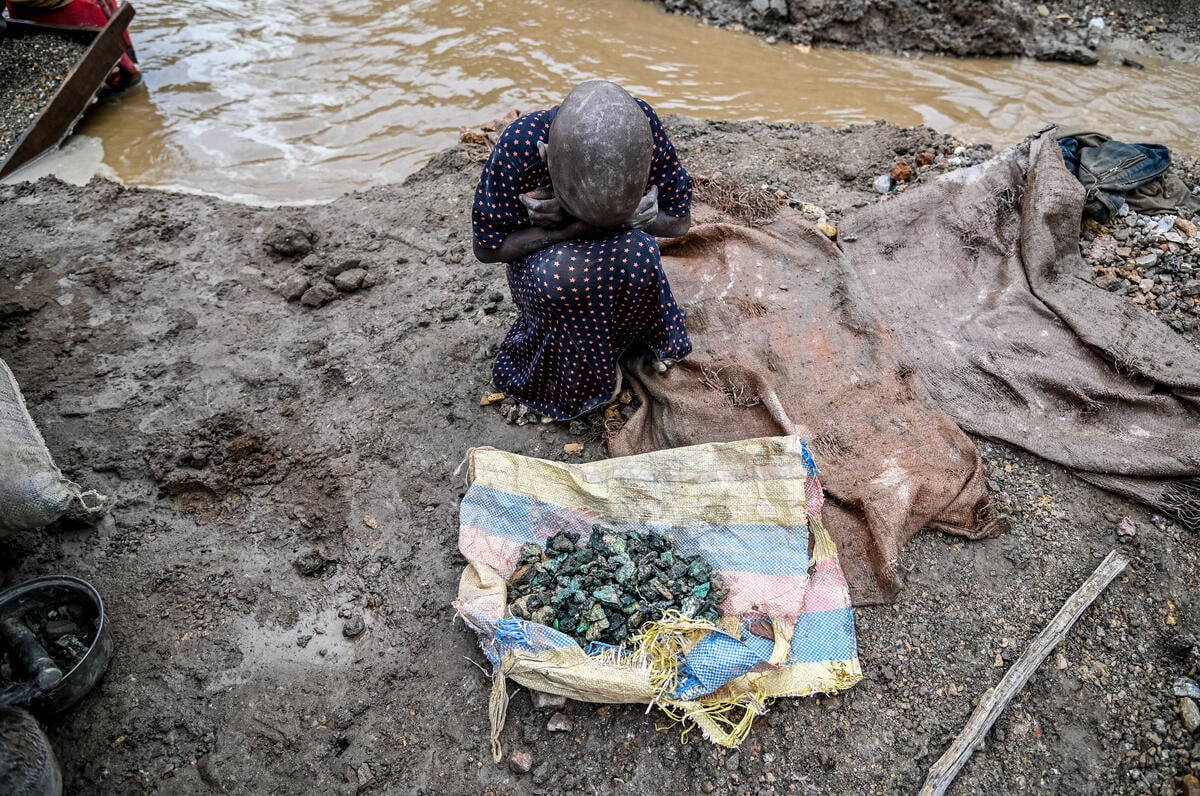
In towns like Kakanda, children as young as 6 work to support their families by selling food on the streets, carrying water, or caring for younger siblings. Children like the young girl shown above dig through toxic rubble with their bare hands, hoping to earn enough for a meal. Without safety gear, they risk injury, illness, or even death. Eleven-year-old Chantal* (not pictured) began working in the mines at age 9 after her father died. “I haven’t been to school in three months,” says Chantal*, who cooks and cleans for her family instead of attending class. “Sometimes I was so tired I’d fall asleep on the ground, right among the rocks,” she says.
Though Congolese law prohibits underage labor in mining, extreme poverty forces many families to rely on income from their children. Most earn less than $2 a day.
*Names changed to protect identity
Taking bits of information throughout the book:
Page 22: “There is no scrutiny at any depots as to the source or conditions under which the ore being purchased was mined.”
“As of my last ground count in November 2021, there were nineteen major industrial copper-cobalt mining complexes operating in Haut-Katanga and Lualaba Provinces, fifteen of which were owned or financed by Chinese mining companies.”
Page 25 and 26:
“Apple introduced the iPhone in 2007, and Android smartphones were launched in 2008. Since that time, billions of smartphones have been sold, and each one of them requires a few grams of refined cobalt in their batteries. … Apple launched the iPad in 2010, followed soon after by Samsung’s Galaxy Tab. Billions of tablets have since been sold, each of which requires up to thirty grams of cobalt in the battery. Add in laptops, e-scooters, e-bikes, and other rechargeable consumer electronic devices, save those with four or more tires, adds up to tens of thousands of tons each year.
“The EV market, however, is where cobalt demand has really exploded….
“Electric vehicles were relegated to a niche market until the push for renewable sources of energy beginning in 2010 led to an electric vehicle renaissance. This renaissance shifted into overdrive after the Paris Agreement in 2015…”
Using Cobalt in Lithium-ion batteries increases battery life and charge time.
Page 29: “Since 2015, the trend with these batteries has been to reduce cobalt reliance by moving toward higher ratios of nickle…”
“The limited supply and high cost of cobalt has not gone unnoticed by the EV industry. Battery researchers are working on alternative designs that can minimize or eliminate reliance on cobalt.”
Adam let me know that he tries to use batteries that are non-cobalt since he’s the one who told me about this horrible Cobalt-mining in the Congo: LFP. He thinks Tesla is using LFP now. I googled, “What type of Batteries are EV makers using now?” on 4/26/26. Here is what AI gave me:
“EV makers currently dominate the market with lithium-ion batteries, primarily utilizing Nickel Manganese Cobalt (NMC) for high performance and Lithium Iron Phosphate (LFP) for lower-cost, safe, and durable standard-range vehicles. NMC dominates in Western long-range models, while LFP has become the standard in China and is rapidly growing in global entry-level EVs.
Key Battery Types Used Today
- Lithium Iron Phosphate (LFP): Known for being cost-effective, safer, and having a longer lifespan, these are increasingly used in standard-range EVs (e.g., Tesla Model 3/Y RWD, BYD).
- Nickel Manganese Cobalt (NMC): Provides high energy density for longer range and performance, common in premium vehicles.
- Nickel Cobalt Aluminum (NCA): Primarily utilized by Tesla for high-power applications.
Emerging Technologies & Trends
- Solid-State Batteries: In the testing phase, expected to offer better safety and higher energy density within 2-5 years.
- Sodium-ion: Emerging alternative to Lithium, aiming to further reduce costs, as mentioned in.
- Cell-to-Pack (CTP): A pack design, heavily utilized with LFP to eliminate modular structure and increase energy density
Major Manufacturers and Chemistry
- LFP: Favored by Chinese manufacturers like CATL and BYD, with increasing adoption by Tesla and Ford.
- NMC: Widely used by LG Energy Solution, SK On, and Samsung SDI, primarily for European and American manufacturers.
- NCA: Primarily associated with Panasonic’s supply to Tesla.”
Page 29-30:
“More than a century ago, E. D. Morel described the Congo Free State as “a gigantic slave-farm reeking with cruelty.” Cobalt mining is the slave farm perfected-the cost of labor has been nullified through the degradation of Africans at the bottom of an economic chain that purports to exonerate all participants of accountability through a shrewd scheme of obfuscation adorned with hypocritical proclamations about the preservation of human rights. It is a system of absolute exploitation for absolute profit. Cobalt mining is the latest in a long history of “enormous and atrocious” lies that have tormented the people of the Congo.”
Page 41: “…He took me on a tour of his village, and the conditions were bleak. There was no electricity or sanitation. Water came from narrow wells ringed at the top by old jeep tires. The villagers subsisted on vegetables grown in a few sallow fields. The closest medical clinic was five kilometers away, and the closest school was seven.
“Makaza’s family used to live in a nicer village much closer to basic amenities, but that village was demolished during one of Etoile’s expansions. Like most of the industrial mines in the Congo, Etoile’s concession has grown across the years, displacing thousands of local inhabitants. Displacement of the native population due to mine expansion is a major crisis in the mining provinces…”
Page 42, talking with some young Congolese: “Kabila sold the mines to the Chinese. All they care about is cobalt, cobalt, cobalt . . . They treat the Congolese people like slaves.”
Page 43, quoting Gloria, one of the young Congolese students: “Let me tell you the most important thing that no one is discussing. The mineral reserves in Congo will last another forty years, maybe fifty? During that time, the population of Congo will double. If our resources are sold to foreigners for the benefit of the political elite, instead of investing in education and development for our people, in two generations, we will have two hundred million people who are poor, uneducated, and have nothing left of value. This is what is happening, and if it does not stop, it will be a disaster.” This was in August of 2018 when Joseph Kabila was still in power. “Kabila has already arranged for [Felix] Tshisekedi to win,” Joseph responded. “He will be Kabila’s puppet. Everyone knows this.”
“Tshisekedi indeed won the election, but in the early months of his term, something unexpected happened–he began to wage an anti-corruption campaign that included scrutiny of some of Kabila’s dealings in the mining sector…”
I googled, “What has Tshisekedi done to help the Congo artisan miners lately?” on 4/26/26. Here is what AI returned:
“Key Initiatives for Artisanal Miners:
Addressing Illegal Exploitation: The administration is facing pressures, with efforts aimed at addressing allegations of improper practices within the sector to protect legitimate artisanal miners.
Gold Sector Formalization (2026): The finance ministry is launching a gold refinery intended to channel 127 metric tonnes of artisanally mined gold into official channels, aiming to reduce smuggling and increase income for miners.
Cobalt Purchasing Monopoly: The government continues to utilize the Entreprise Générale du Cobalt (EGC) as a state-mandated entity to handle and market artisanal cobalt, ensuring legal sourcing and aiming for better safety conditions.
Safety and Working Conditions: The government is encouraging partnerships, such as those at the Kibali mine, to create dedicated artisanal zones (ZEAs) and implement programs for safer working conditions.
Security for Mineral Areas: Tshisekedi has sought international partnerships, including with the U.S. and China, to improve security in mineral-rich eastern areas and ensure that mining, particularly for cobalt and gold, can continue legally.”
Page 45: “…At its peak, Gecamines Sud employed thousands of citizens and produced tens of thousands of tons of copper annually. Operations at the mine ceased in the early 1990s, and the site has been dormant ever since. Inside the derelict concession, a one-hundred-meter mountain of slag and rubble sat next to the towering chimney of the mineral-processing facility. Tangles of metal lay rusting across wide fields of dirt. All was ashen and pale under the hazy radiance of the sun.
“Gecamines Sud was a picture of what mining had done to the Congo-a once great land reduced to ruin. From the ruins, a new breed of mining was born, one that was more violent and voracious than ever. As we will discover with each passing mile on the road to Kolwezi, the rechargeable battery revolution has unleashed a malevolent force upon the Congo that tramples all in its path in a merciless hunt for cobalt.”
The basis for China’s infiltration into the Congo started in 2000 under President Jiang Zemin. Page 46: “The relationship was billed as a win-win: The Chinese would build much-needed roads, dams, airports, bridges, mobile networks, and power plants across Africa, and in exchange, China would secure access to vital resources to support its growing economy. In 2006, President Hu Jintao deepened the economic ties with a Sino-African summit in Beijing that was attended by forty-eight African heads of state. A deal was struck between SICOMINES and Joseph Kabila in which SICOMINES agreed to provide $6 billion toward construction of roads and $3 billion toward upgrading mining infrastructure in Katanga. The money was to be repaid through the value of copper-cobalt deposits excavated by SICOMIES. If the deposits provided insufficient, the DRC agreed to repay the loans through “other means.”
The World Bank and the International Monetary Fund exerted pressure and the “other means” clause was dropped and the the loan amount reduced from 9 billion to 6 billion. Joseph Kabila immediately began profiting from tolls and in other ways. Page 47: “The nation, however, has seen little profit from the SICOMINES agreement. Infrastructure projects have been delayed, road quality has been poor, and there has been little by way of environmental or social impact considerations in the construction and mining operations of SICOMINES. Crucially, the SICOMINES deal is exempt from taxes until infrastructure and mining loans are fully repaid, which means that the DRC will not receive meaningful income from the deal for many years to come.”
Page 52: “…Heterogenite. I studied the stone closely. It was dense with a rugged texture, adorned with an alluring mix of teal and azure, speckles of silver and patches of orange and red–cobalt, nickel, copper. This was it. The beating heart of the rechargeable economy. Heterogenite can come in the form of a large stone, such as the one Philippe handed to me, or as smaller pebbles, or weathered down into sand. Cobalt is toxic to touch and breathe, but that is not the biggest worry that the artisanal miners have. The ore often contains traces of radioactive uranium.”
Page 54-55, he describes two boys, 8 and 10 years old, tasked with washing the mined rocks: “…The pool of water was a putrid, bubbly, copper-colored swamp. …
“The boys tipped the sack over and emptied the contents by hand into a large pile next to the washing pool. Andre stepped bare-skinned into the noxious water and picked up the sieve by two handles at one end. He lodged the other end of the sieve into the dirt at the edge of the pool. Kisangi used the small shovel to scoop the contents of the sack onto the sieve. Andre then vigorously yanked the sieve up and down through the surface of the water, separating dirt from stone. His tiny shoulders looked as if they would pop out of their sockets with each jolt. After a few minutes, only pebbles remained in the sieve. Andre appeared exhausted and barely managed to hold the sieve above water while Kisangi scooped the pebbles out by hand and placed them in a pile. The children would repeat this arduous process another ten or fifteen times to sieve all the stones from the sack, and they had to sieve several sacks each day.”
Page 58: “…I wandered back into the mining area to take a final look before darkness fell. The devastated landscape resembled a battlefield after an aerial bombardment. The survivors of the day’s assault clambered out of the craters and trudged back to their huts to catch what little rest they could before returning to endure the ordeal all over again the following day.
“A lone girl stood atop a dome of dirt, hands on her hips, eyes cast long across the barren land where giant trees once ruled. Her gold-and-indigo sarong fluttered wildly in the wind as she surveyed the ruin of people and earth. Beyond the horizon, beyond all reason and morality, people from another world awoke and checked their smartphones. None of the artisanal miners I met in Kipushi had ever even seen one.”
Page 60-61, describing a researcher’s findings:
“In the studies we conducted, the artisanal miners have more than forty times the amount of cobalt in their urine as the control groups. They also have five times the level of lead and four times the level of uranium. Even the inhabitants living close to the mining areas who do not work as artisanal miners have very high concentrations of trace metals in their systems, including cobalt, copper, zinc, lead, cadmium, germanium, nickel, vanadium, chromium, and uranium…”Even if children to not work in the mines, indirect exposure to heavy metals from their parents is worse for them than direct exposure for the adults. This is because a child’s body cannot remove heavy metals as well as adults can.” Germain added that humans weren’t the only ones suffering toxic contamination–wildlife such as fish and chickens that he tested also showed very high levels of heavy metals….
“…For instance, Germain had recently documented a high rate of birth defects in mining communities, such as holoprosencephaly, agnathia otocephaly, stillbirth, miscarriages, and low birth weight….samples of cord blood taken at birth revealed high levels of cobalt, arsenic, and uranium…’hard metal lung disease’…acute dermatitis.. cancers on the rise…lead poisoning were also widespread…dust inside homes 170 micrograms of lead per square foot… the EPA in the US recommends a maximum safe limit of 40 micrograms of lead per square foot inside homes. Levels as high as 170 micrograms per square foot can cause neurological damage, muscle and joint pain, headaches, gastrointestinal ailments, and reduced fertility in adults. In children, lead poisoning can cause irreversible developmental damage as well as weight loss, vomiting, and seizures.”
“…There is no training of doctors to diagnose and treat health ailments arising from contamination by heavy metals…”
Page 62: This researcher “had particularly strong words for foreign mining companies:
“The mining companies do not control the runoff of effluents from their processing operations. They do not clean up when they have chemical spills. Toxic dust and gases from mining plants and diesel equipment spreads for many kilometers and are inhaled by the local population. The mining companies have polluted the entire region. All the crops, animals, and fish stocks are contaminated.”
Page 65 describes the handing off of responsibility from one entity to another to the destruction of the miners of the Congo – no one cares, no one wants to take responsibility. If they would only pay the adult miners more, their children could go back to school, they could afford medical care. But the foreign mining companies say they don’t employ artisanal miners (yet the cobalt they mine ends up in their supply chain just the same). The government of the DRC says they don’t have the money but they are raking in billions. The companies using the Cobalt (“Cobalt refiners, battery manufacturers, tech and EV companies”) say it is not their responsibility even though their need for cobalt is what has caused the mining to take place in the first place. “Therein lies the great tragedy of the Congo’s mining provinces–no one up the chain considers themselves responsible for the artisanal miners, even though they all profit from them.”
Page 67-68: “”According to the OECD [Organisation for Economic Co-operation and Development], up to seventy percent of the cobalt from the DR Congo has some touch with child labor…”
“…This fact alone indicted a preponderance of the global supply chain of cobalt, yet child labor was far from the only problem in the Congo’s artisanal mining sector. How much of the Congo’s cobalt was “touched” by the hundreds of thousands of Congolese people suffering the consequences of toxic exposure to cobalt, uranium, lead, nickel, mercury, and other heavy metals? How much was touched by the infants who inhaled hazardous mining dust every day at artisanal mines? What about the noxious gas clouds and toxic dumping that contaminated the air, land, crops, animals, and fish stocks of the Copper Belt, and what about the millions of trees chopped down to make way for enormous open-pit mines? Let us not forget the unknown number of people who were injured or worse in mining accidents. By the time one tallied such a list, how much cobalt would be left in the world that was untouched by catastrophe in the Congo?”
Chapter 3, page 69: “Nothing looks the same after a trip to the Congo. The world back home no longer makes sense. It is difficult to reconcile how it even inhabits the same planet. Neatly arranged mountains of vegetables at grocery stores seem vulgar. Bright lights and flushing toilets seem like sorcery. Clean air and water feel like a crime. The markers of wealth and consumption appear violent. Most of it was built, after all, on violence, neatly tucked away in history books that tend to sanitize the truth.
“We are rarely asked, if ever, to confront the untold suffering that has been endured by Africa…”
Page 70: “Imagine for a moment the toll taken on a person, a family, a people, a continent across centuries of the slave trade, followed by a century of colonization. Empires were built and generations of wealth were amassed across the Western world in this manner.”
…”According to a mid-level manager at Congo DongFang Mining (CDM) who goes by the name of Hu, the people of the Congo, and Africa more generally, suffer exploitation because they are lazy.”
Page 73, he describes the start of mining in the Congo. It started with copper by the Belgians in the early 1900s and then, uranium in 1915. Although the uranium mine is shut down, “rumors persist that rogue army officials and organized criminals excavate uranium and sell it on the black market to the likes of Iran, North Korea, and Pakistan.”
Pages 82-84, he describes Edmund Dene Morel, an Englishman who worked for the company who handled all of King Leopold’s shipments from the Congo. Morel was tasked with analyzing them and “uncovered one of the greatest human rights catastrophes in history.” He published a book, “Affairs of West Africa” in 1902. In it, he exposes the exploitation of Belgian King Leopold on the peoples of the Congo – “invented a form of slavery more degrading and more atrocious than any slavery which has existed previously.”
“Morel and Casement met in England and formed the Congo Reform Association (CRA) in March 1904 to bring down Leopold’s colonial regime. The CRA became the first international human rights organization of the twentieth century, driven by the power of data (Morel) and survivor testimonies (Casement). Joseph Conrad, Arthur Conan Doyle, Mark Twain, and Booker T. Washington were among the many supporters of the CRA. By 1908, Leopold was forced to sell the Congo Free State to the Belgian government, bringing an end to one of the most brazen systems of slavery in the history of Africa. Or so it seemed.”
Page 86-87: “It may never be known just how much money Joseph Kabila extracted from Chinese mining contracts and construction deals. His apparent ransacking of mining assets and public funds would put even Leopold to shame.”
Page 92-93, describing Nikki and Chance, young mothers (fifteen and fourteen years-old), each with babies. They hike to the mines 30 minutes there starting at dawn, and back every day, with their babies, a one year-old daughter and a newborn son. They worked together every day, most likely for protection against rape, which is a common injustice to unprotected female artisanal miners. “Nikki’s daughter began to cry loudly. Nikki did her best to console the infant by instinctively rocking and patting her, but the baby only cried more. Nikki seemed to be getting frustrated, so I turned to Chance and tried to ask a few more questions of her, but she said she had to return to digging. She gently placed her sleeping son into a cardboard box next to the trench and climbed down in labored movements into the muck. Nikki was having no success at consoling her daughter. She tried to feed her, but the infant did not respond. Her cries turned to shrieks. Was she colicky? Had she soiled herself? How did one care for a baby in circumstances such as these, especially when the mother herself was a child? Arthur motioned that we should continue down the trench. As we moved on, I peeked inside the cardboard box at Chance’s son. His diminutive chest pumped up and down rapidly as he slept under the scalding sun, inhaling unknown hazards into his tiny lungs.”
He gives the history of the Congo. First, the slave trade from 1482-1884. Then, colonization from 1885-1960. Belgian King Leopold was brutal, first with ivory–mass poaching of elephants, and then with rubber; cars with wooden tires and internal combustion engines, invented by German, Karl Benz, in 1885; and then rubber tires invented by Scotsman, John Boyd Dunlop, in 1888. Leopold forced the natives of the Congo to extract rubber from the vines of rubber trees, using a “flesh-shredding whip.” If they didn’t meet quotas, they cut off hands, noses, or ears.
“Joseph Conrad witnessed the atrocities of Leopold’s regime when he journeyed on the Congo River, beginning on June 13, 1890. He kept a diary in two black penny notebooks filled with impressions that would one day yield his excoriating meditation on the colonial desecration of Africa, Heart of Darkness.“
Then in 1911, copper and other minerals began to be mined. Then palm oil trees which was an ingredient in soap – the Belgians sold a huge chunk of rainforest to the Lever brothers, and they became the “multinational powerhouse Unilever.”
Then, “Hope Born and Destroyed: 1958-January 1961”
They won independence and elected Patrice Lumumba, a humble and caring individual who was going to govern fairly and justly and return Congo to the Congolese people.
Page 110: “Eleven days after independence, the Belgians executed a brazen plan to keep control of what mattered most in the Congo–the minerals of Katanga. They backed Moise Tshombe in announcing that Katanga Province had seceded from the Congo…With surgical precision, the Belgians had severed Katanga Province like a hand from the body of the nation, and with it, 70 percent of the government’s income. The country was crippled before it ever had a chance.
“Lumumba wrote to the United Nations asking for assistance in expelling the Belgians and reunifying the country. The UN responded with the largest ground operation since its creation to help stabilize the nation, but the forces were not authorized to expel Belgian troops. Lumumba turned instead to the Soviet Union for help. The possibility that the Congo, and especially Katanga, might come under Soviet influence put the United States, the United Nations, and Belgium into overdrive to dispatch Lumumba.”
What follows is a travesty – we [USA under Eisenhower first] decided we had to get rid of Lumumba and recruited Joseph Mobutu. He, on 9/14/1960, announced that he had overtaken the government. He expelled Soviet Troops and put Lumumba under house arrest. Lumumba managed to escape; we helped recapture him. Kennedy persuaded Belgium to take Lumumba somewhere and execute him. The Belgians took him to an isolated mansion; they, along with Mobutu forces, tortured him for hours, then assassinated him, chopped him up and put his body parts in sulfuric acid. They ground him up, save one tooth, kept as a souvenir by the Belgian commissioner of the Katangan police.
“Hell on Earth: February 1961-2022”
Page 111-112: “With the nationalist threat neutralized, the United Nations sent troops to force Katanga to reunify with the Republic of Congo, which is all Lumumba ever wanted.” Then follows violence for 3 1/2 years, before Mobutu takes over the government in another coup on 11/24/1965.
“Mobutu ran the Congo for thirty-two years, just as Leopold did–a personal wealth machine. …he took direct ownership of several mining concessions. He siphoned billions of dollars from the country’s mineral exports into personal bank accounts, becoming one of the ten richest people in the world during the 1980s.”
“Mobutu remained in power for decades, despite overt corruption, by embracing the U.S. cause against communism, which brought him the unwavering support of Presidents Nixon, Bush, Reagan, and Clinton. Katanga’s minerals flowed to the West, and the proceeds flowed into Mobutu’s bank accounts.”
Page 115: Tshisekedi wins the election on December 30, 2018 and is inaugurated on January 25, 2019. That “marked the first peaceful transfer of power in the Congo since the country’s independence in 1960.”
“…within a few months of taking office, Tshisekedi initiated an anti-corruption campaign targeting the mining sector.”
And thankfully, Tshisekedi remains in power, after the election in 2023.
The largest cobalt mine in the Congo is called Tenke Fungurume. It’s as big as London.
Page 132: “As the ruckus from the highway faded, I caught the sound of a chorus. The uplifting voices drew me to the Eglise Alliance Chretienne Internationale (International Christian Alliance Church). Inside, I found a large room packed with congregants. They sang passionately, led by a vibrant pastor atop a small wooden platform. A child looked at me, his wide eyes alight and comforting. I understood at last how the people of the Congo survived their daily torment — they loved God with full and fiery hearts and drew comfort from their promise of salvation.”
It is tragic how many children and adults have died by being buried alive in tunnels that collapse, mining for Cobalt. Everyday, they fear for their lives. Many drink to numb the fear. Then there are the ones who are severely injured, and left wishing they had died; they get minimal care from hospitals and clinics, and their families, already so poor, are left trying to care for them.
He recommends using Google Earth to look at the mine, Kolwezi. I did that and it is huge and the surrounding city immense. The open-pit mine takes up everything. It’s ugly and I know the mining companies will never undo what they have done. They’ll exploit, pollute, ruin, decimate and then leave. How awful. We as a world need to demand they clean up their mess, starting right now.
Page 168: “The land was a hellscape of craters and tunnels, patrolled by maniacs with guns. An obscuring pallor hung thick above the terrain, as if the earth itself could not bear to be seen…”
“…All around me, children were clambering up and down the hill in bare feet, or, if they were lucky, in plastic flip-flops. One child passed by on his way down the hill, deftly navigating the same treacherous terrain under the weight of a raffia sack stuffed with stones…”
Page 178-180: “If there was one face of this misery, one child debased by piracy cloaked as commerce, it was Elodie. I met her toward the end of my first visit to the KCC mining area. She was fifteen years old, foraging in the dirt near the periphery of Lake Malo in a faded orange sarong with purple birds dancing on it. She was scarcely more than bones and sinew. Her raw-boned face was crusted with mucus, her hair knotted in clumps of dirt. She suffered from a rib-cracking cough. Her feeble two-month-old son was wrapped tightly in a frayed cloth around her back. His tiny head flopped side to side each time she hacked at the ground with a piece of rebar. I’d seen enough to know what the late stages of an HIV infection looked like, and it looked like Elodie. Although she moved over the earth with the shape and semblance of a child, she was the nullity of the word.
“Elodie was orphaned by cobalt mining. She said her father died in a tunnel collapse at the KCC site in August 2017…Elodie’s mother had died around a year before her father. She washed stones at Lake Malo, and as best as Elodie could recall, her mother contracted an infection from which she was unable to recover. After the loss of her parents, Elodie said she turned to prostitution to survive….
“…Elodie slept in an abandoned, half-finished brick hut near the southern edge of Kapata with a group of orphaned children….There are thousands of shegues, across the Copper Belt, and they survive by any means necessary…
“Elodie was one of the most brutalized children I met in the DRC. She had been thrown to a pack of wolves by a system of such merciless calculation that it somehow managed to transform her degradation into shiny gadgets and cars sold around the world. The consumers of these devices, were they to stand next to Elodie, would appear like aliens from another dimension. Nothing in form or circumstance would bind them to the same planet, aside from the cobalt that flowed from one to the other.”
Page 214: “…At just five or six dollars a month, the fees per child required to keep schools functional are so small that even a modest amount of funding could help solve the problem. Put another way, the monthly fees per child required to keep Congolese children in school and out of mines was equal to two Primus beers at Taverne La Baviere.”
“As I left, the officials ordered a third round.”
Page 216: “The essence of Kasulo is a devil’s gamble: tunnel diggers risk their lives for the prospects of riches. Mind you, the “richest” income I documented in Kasulo was an average take-home pay of $7 per day. There are spikes to $12 or even $15 when a particularly rich vein of heterogenite is found. That is the lotto ticket everyone is after. The most fortunate tunnel diggers in Kasulo earn around $3,000 per year. By way of comparison, the CEOs of the technology and car companies that buy the cobalt mined from Kasulo earn $3,000 in an hour, and they do so without having to put their lives at risk each day that they go to work.”
There is no social interaction between the Chinese and the Congolese. There are many biases – it is only a transactional relationship. The Chinese refuse to eat any food touched by a Congolese, so they eat only in their own restaurants. The Chinese treat them like animals and think they are dirty. The Congolese think the Chinese are like robots because they can stay away from their families for a year at a time. But worst of all is that the Chinese burn their bodies – cremate their dead.
Page 230: “When a tunnel collapses in Kasulo, most bodies are never recovered. The family members are unable to give their loved ones a proper funeral. They are compelled instead to walk each day upon their dead…”
Page 240: “Sixty-three men and boys were buried alive in a tunnel collapse at Kamilombe on September 21, 2019. Only four of the sixty-three bodies were recovered. The others would remain forever interred in their final poses of horror. No one has ever accepted responsibility for these deaths. The accident has never even been acknowledged.”
In the Epilogue, he describes meeting the Congolese ambassador to the U.S., Francois Nkuna Balumuene. Page 241: “We found common ground in the belief that foreign companies should share more of the wealth they generated from Congolese cobalt with the people who dug it out of the ground for them. We discussed the importance of ensuring the safety and dignity of the Congo’s artisanal miners, as well as the need to protect the environment across the Copper Belt with more sustainable mining practices.” The ambassador felt it was the duty of the people of Congo, however, to speak for themselves, and if he really wanted to help, to “go back and assist local researchers in doing so.”
Covid caused many of the foreign mines to close and put more pressure on the Congolese to provide cobalt for the many people working on rechargeable devices at home throughout the world. COVID spread quickly in the mines and the miners spread it to their families. And the vaccine was scarce. The vaccine that was provided was a Chinese vaccine and the Congolese did not trust it. The price for the miners’ cobalt was reduced because there were fewer depots buying since the Chinese were gone. This resulted in the miners’ incomes reaching rock bottom and no one being able to afford school, much less food, clothing, and housing. More children left school to dig for cobalt.
Page 244-245: “Rather than issue vacant statements on zero-tolerance policies and other hollow PR, corporations should do the one simple thing that would truly help: treat the artisanal miners as equal employees to the people who work at corporate headquarters. We would not send the children of Cupertino to scrounge for cobalt in toxic pits, so why is it permissible to send the children of the Congo? We would not accept blanket press statements about how those children were being treated without independently verifying it, so why don’t we do it in the Congo? We would not treat our hometowns like toxic dumping grounds, so why do we allow it in the Congo? If major technology companies, EV manufacturers, and mining companies acknowledged that artisanal miners were an integral part of their cobalt supply chains and treated them with equal humanity as any other employee, most everything that needs to be done to resolve the calamities currently afflicting artisanal miners would be done.”
He includes this beautiful paragraph and a letter that follows as the end of the book, Pages 248-249: “One final voice calls to us from the Congo. The nation’s greatest freedom fighter and first prime minister, Patrice Lumumba, described his dreams for the future of the country in his final missive to his wife, Pauline, just before he was assassinated. One can imagine the letter being addressed equally to the Congo itself. Lumumba’s dream was tragically snuffed out by those who would let nothing stand between them and their scramble to loot the country’s resources. Such has been the Congo’s nightmare for centuries.”
Here is part of the letter:
“What is important is the Congo, our poor people whose independence has been turned into a cage, with people looking at us from outside the bars, sometimes with charitable compassion, sometimes with glee and delight. But my faith will remain unshakable. I know and feel in my very heart of hearts that sooner or later my people will rid themselves of all their enemies, foreign and domestic, that they will rise up as one to say no to the shame and degradation of colonialism and regain their dignity in the pure light of day.”
And last but not least, the very last paragraph of the book, in the Acknowledgments, Page 252:
“Above all, my beloved wife, Aditi, carried this heavy burden with me and gracefully absorbed all that it did to me. I was at times heartbroken, angry, and shell-shocked by what I witnessed in the Congo. Her love and strength carried me through every step of this journey. I would never have crawled out of the darkness without her.”
What an excellent book, one that every American should read buy and read.