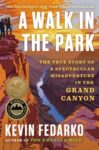
by Kevin Fedarko, 2024
Adam recommended this book. It’s by the author of The Emerald Mile, the book about Kenton Grua’s fastest run down the Colorado in 1983 in a wooden dory named after a stand of Redwood trees that were partially clear-cut. That was an excellent book. This one is even better. Kevin Fedarko’s writing is honest, humble, and the details he provides make you feel like you are there. This book is a great work of art, like the canyon itself. He and his friend and photographer/journalist, Pete McBride, decide to do a “through-hike” of the Grand Canyon, which is about a 750-mile slog through dangerous no-man’s lands, along the rim, half-way up the sides of the canyon, sometimes along the river, sometimes on the south rim, other times on the north rim, up and down slot canyons, scrambling under Tamarisks, in extreme heat, extreme cold.
The first leg they do is “off the couch” and they last 6 days and go home in shame, about dead. They didn’t bother to train. Kevin didn’t bother to open any of the boxes of supplies that were shipped to them. They brought all of the boxes unopened and when they got to their remote starting point, they opened them and haphazardly packed what they thought they would want/need. They ended up with packs that weighed 58 lbs. The experts they were tagging along with were very kind but very leery. After 6 days of unbelievable hardship, they had to be rescued, and the 4 experts had to make up lots of time to stay on track for their own through-hike. Kevin and Pete were never going back again, but these experts had friends that swooped in, showed Kevin and Pete how to do this, and then went with them for the next leg. That was a completely different experience. Kevin and Pete had been humbled and they were much better prepared this time.
They do 3 more journeys, starting where they left off each time so that they could say they did the “through-hike” which is about 750 miles total when all is said and done. It took a year. There is no continuous trail to get from one end to the other and Kevin begs his readers NOT to ask their congressmen to authorize one – it would be another step in the destruction of this place. What is interesting is that Kevin had to go back after he and Pete did the last leg and do an easy portion that he couldn’t do with Pete earlier. He did that leg after his father died and he did it with his brother, Aaron. They had a wonderful time together. They reminisced about their beloved Dad who died of cancer. But Kevin left a small portion of the hike undone – he didn’t feel he belonged on the short-list of experts who had completed a through-hike of the Grand Canyon. Pretty humble. He likened it to the Navajo rug weavers who always leave one spot incomplete/imperfect.
When Kevin was a boy in Pittsburgh, his dad gave him a paperback book he bought at a garage sale. It was a book by Colin Fletcher called The Man Who Walked Through Time, which had a cover that entranced Kevin – a man standing on the edge of the Grand Canyon. Kevin fell in love with the Grand Canyon. And no wonder – he grew up in Pittsburgh where steel mills had polluted everything. The air was filthy. The landscape was pretty much destroyed from coal mining to run the steel mills. Their dad would take he and Aaron hiking on “spilly piles” – the black slag leftover from coal mining. But their Dad had only ever known this and the joy he felt in taking his boys hiking there stayed with them. Kevin wonders how his Dad could have been so positive in such an ugly place and he realized his Dad was full of gratitude. His Dad’s father had spent 50 years of his life in a coal mine, so Kevin’s Dad was grateful for his life.
Kevin is honest about how woefully unprepared he and Pete were on that first leg. It’s almost a comedy except it could have been deadly. The people they were with were amazingly patient and kind. They tried to help them but there was only so much they could do. One of them snuck into Kevin and Pete’s tent in the middle of the night and took out a heavy telephoto lens that Kevin was carrying for Pete, to lighten Kevin’s load somewhat. They were relieved when Pete and Kevin called it quits, so they could go on without them. One, however, would not let them quit. His name is Rich Rudow, and he knows the canyon like no other. He’s the one who arranges for 3 of his friends to immediately descend upon Kevin and Pete once they get home, and get them well-prepared and back to the hike. They even go with them for the 2nd leg of the journey. You find out at the very end of the book why Rich wouldn’t let them quit – he wanted them to tell the story of the Canyon – Kevin through his words and Pete through his pictures. And wow, did Kevin tell the story. This is a magnificent book. He tells you everything you need to know about the Grand Canyon, and so picturesquely. I learned so much!
There are 11 Native American Tribes who called parts of the canyon home centuries before the white man came and cruelly kicked them out, ruining their lives. Three of the tribes have been given back some of their canyon land. The Havasupai used to live summers down by the river where they planted and harvested, and winters up on the rim where they hunted and gathered. The US Government finally gave them some of their land back, but their lives were already shattered; they are destitute, diabetic, depressed, suicidal, alcoholic, and now meth addiction has led to them being crime-ridden.
Another tribe, the Hualapai, have made almost a theme park of their part of the canyon – the far western part. They have the Skywalk (an idea that came from a rich Chinese tourist who had it built and ran it for a while) and they have helicopter tours – about 250 a day – that have made that part of the canyon hellish with the noise and the commercialism. They also have motorized boat tours up the Colorado River. But Kevin understands where they are coming from – they either do nothing and become destitute, or they do what’s been done to them by the white man, exploit for profit. The helicopter tours, motorized boat tours, and Skywalk provide jobs, fund education and improvements and a better life for their tribe. They’ve also incorporated a museum and interpretive center at the Skywalk where tourists can learn about their history and culture. It’s also a place they can perform native dances and ceremonies that keep their traditions alive. There’s a time lapse picture in the book where the sky is full of helicopters and the river is full of boats – showing how many helicopters and motorized boats come and go in this spot during an 8 hour period. It’s a conundrum.
He tells the story of the proposed Escalade Development by developer R. Lamar Whitmer, who really wants to develop on the southeastern rim in the Navajo Nation. He wanted a hotel, shops, a tramway (all the way from the top of the canyon to the bottom), walkway, and restaurant. Thankfully, the group, “Save the Confluence,” headed by Renae Yellowhorse, whom Kevin and Pete meet and talk with, successfully opposed the development and it was voted down in 2017 by a large majority (16-2). It is a constant battle, though, to keep developers away from the money to be made in tourism at the Grand Canyon.
He tells the story of Andrew Holycross and his precious wife, Ioana Elise Hociota, a Romanian immigrant. She had only one part to complete for a through-hike. He couldn’t go along because he was a zoology professor and teaching classes. She went with another person and they were hiking on the Great Thumb Mesa in a particularly dangerous spot and she slipped and fell off a cliff, 400 feet to her death. She was only 24 years old. Andrew Holycross is a snake expert and when Kevin and Pete meet him, it’s at the very beginning of their hike, when they are so ill-prepared. Andrew looks like a bum – rumpled, messy hair, unshaven, holding a can of beer in the morning as the group is about to set off, torn t-shirt, shorts with a broken zipper. He was someone that Kevin thought to avoid until Pete said his name and Kevin realized he really wanted to meet this guy. He’d hiked the entire length of the Grand Canyon twice. He was there as the group was setting off, walking the first part – an easy walk on a dirt road. He was really intent on walking with Kevin and Pete and maybe trying to see if they were going to be able to do this or not. At that point, they really wouldn’t have been able to do it – 58 lb. packs, totally unprepared in every way – physically, mentally, etc. But he walks along with them and talks with Kevin about a snake Kevin saw on a hike near Flagstaff. Andrew was not happy that Kevin couldn’t describe it very well. It was a warning to Kevin, he realized later, to pay attention. And then, when they are on the Great Thumb Mesa, the spot where Andrew’s wife slipped and fell to her death so tragically, Kevin realizes how amazing it was that Andrew bothered to talk with him at all – he had seen firsthand and so tragically what hiking the Grand Canyon can cost.
I like that Kevin starts out the book, first with his childhood in filthy Pittsburgh, and then describing his early years as a river-boat guide (he captained the Jackass, the boat that holds all the solid waste containers on guided river trips through the Grand Canyon). You learn all about the luxurious river trips – all the delicious food and drink, the comfortable chairs and sleeping arrangements, the short, scenic hikes you do near the river. Doing a through-hike is nothing like those trips at all. The through-hike is grueling, brutal, deadly.
One of the reasons they had to quit when they first started their hike was because Pete got so dehydrated and off-kilter that it looked like a rodent was crawling around under the skin of his abdomen. He had lost too many electrolytes in addition to being dehydrated. Very, very dangerous situation.
Later on, when they are near the end, he describes some really strange petroglyphs they saw, called “polychrome pictographs.” Twelve human-like figures but with faces that have no eyes, ears, nose, or mouth. Some were about 6 feet tall, some had 6 digits on their hands. Their bodies were like sections of insects. They are thought to be 4000 years old.
He talks about the stars you can see at night – unlike anything I’ve ever seen. I would love to see that many stars. Like “an ocean speckled with silver.” It’s called “celestial vaulting.” “A sky whose wildness can call forth and amplify the wildness of the land–and perhaps, too, the wildness within oneself–by offering up a glimpse of the darkness that our earliest ancestors once knew, back when humans must have lived in almost continuous humility and awe, transfixed by the inescapable sense of just how small and unimportant they were–little more than Tadpole Shrimp or Spadefoot Toads, creatures unburdened by delusions that the world could be sculpted to suit their ambitions and needs.”
Before Kevin’s dad died of cancer, Kevin flew him out to see the Grand Canyon in person. Kevin took him (and Kevin’s Mom, Kevin’s brother and his wife and two boys) first to the North Rim to see the aspens and wildflowers in the meadows of the Kaibab, then to Lee’s Ferry to touch the river, then to a magnificent place on the South Rim called Lipan Point. There’s a steep hiking trail that you can do a bit of but Kevin stayed with his Dad and they talked. His Dad unequivocally said “No” when asked if he thought a tram being built would be a good idea. Kevin asked why not? His dad answered, “Because of them,” and pointed to the rest of the family hiking down the trail. Kevin realized he meant the little boys. Kevin writes about telling his brother, Aaron, about this conversation with their father, “But I think he felt that running a tramway down those walls would diminish the world that his grandsons will one day inherit. And I think he understood that to mean that if part of protecting a national treasure like this involves banning things like cable cars and gondolas, then people like him will have to park themselves on a wall while others get to go off and explore, like you guys did.”
One of the last paragraphs when he and his brother end their hike on the very popular Bright Angel Trail, where all sorts of tourists are walking; every age, fitness, body type, footwear, etc. “They were pilgrims because they had come to a holy place–a cathedral in the desert–in the hope of standing in the presence of something greater than themselves, something that would enable them to feel profoundly diminished and radically expanded in the same breath. They were pilgrims because there was something sacred in the belief that despite its ugliness and its many depravities, there are still places in our fallen and shattered world where wonder abides.”
Right before his father dies, Kevin was able to show him Pete McBride’s coffee table book of pictures of their through-hike of the Grand Canyon. Kevin was able to take a picture of his Dad looking intently at one of the photographs. “He was counting his blessings as he prepared to head off on the grandest walk of all.” Beautiful Epilogue ending.
The Acknowledgements section is really touching. Kevin thanks so many people and at the very end, he says he always thought the canyon stole his heart but “…the keepers of everything that matters most to me are Cora, Thad and Maddox.” They are his 3 children, and he says about his wife, Annette, that “She’s bedrock.”
Such a good book! When I finished, I missed being in the canyon with Kevin and Pete. Kevin writes so well, you are there with him.