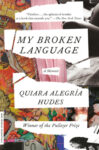
by Quiara Alegria Hudes, 2021
I got this book from a Little Free Library in the neighborhood. It is a memoir and won the Pulitzer Prize. I apologize I cannot figure out how to put the accent mark over the “i” in Alegria. Her mother is Puerto Rican (“Philly Rican”), one generation removed; her father is white, Jewish, hippy. She grew up in Philadelphia. Her Mom and Dad divorced when she was young (he was unfaithful to her mom), she lived mainly with her Mom in North Philly and visited her Dad in suburbia frequently at first, then less and less frequently. He married a white bitch named Sharon, who told Quiara on their wedding day, to stay out of the family pictures, “This is my day.” Quiara went away into the woods (it was an outdoor wedding near the farm at which they had been living) and she dealt with the hurt and shame by vowing solitude – the only safe way to be. “Solitude was reliably safe and enjoyable. The woods understood that, they had taught me well. I spent a long time visiting my old friends: the ferns, the toads, the moss. Finally, relief found me, now that I had decided who to be. The girl alone. The girl who despises the English word “my.””
Quiara looks like a white girl, but she lives with her Puerto Rican family and loves them – her aunts, uncles, cousins, her Abuela. They live close to poverty. There is tragedy. This is when the AIDS epidemic begins and she loses 3 beloved relative to AIDS, possibly. There was uncertainty over their deaths; sores all over, a slow wasting away. The wife and mother (I believe the deaths were all from one Aunt’s family – her husband and 2 of her children) grieved loudly – falling on the floor and screaming- at their funerals.
She spent her childhood watching, listening, being with all of these beloved people. The dancing, the music, the cooking. Her Mom began to worship deities (Santeria). She created altars to them in the house. Quiara was both intrigued and ashamed – her friends would come over and see them and never come over again. One night, Quiara heard a male voice she had never heard before. She tiptoed down to the kitchen and her mom was possessed and speaking like a male. She was with two of her friends – she was guzzling rum – half the bottle – and she never drank before. The friends would ask a question and give her rum and when she answered they would take notes. She even looked different – her face had widened and nose flattened out. Her Mom is a wonderful woman – very brave, very caring – trying to help the poor; getting the young mothers the prenatal care they need, educating them on how to get and stay healthy, advocating for them in the local governments. Quiara accompanies her all over the place and listens to her Mom and learns.
Her Mom ends up marrying a big, kind man – a Puerto Rican – a businessman and hard worker. He and his workers lug a piano up the stairs and into the house, for Quiara. She is a prodigy! I think she teaches herself by listening to classical music. She ends up going to a good high school, getting a scholarship into Yale (her grandma thinks she is going to Jail). She majors in music. She writes music. She graduates. She works. Then she decides to enroll in a master’s program for writing and moves to Providence. She marries “the boy.” They fell in love in high school and he went off to college and she went off to college and they never stopped loving each other. In the end, she is 40 years old, married, 2 children, and a writer. She has found her voice. She was possessed 4 times in her life – each time resulted in a torrent of writing. The last time was when she had writer’s block and could not finish her play. She was in the library and was overtaken and started typing and typing and typing. When she “woke up” she had written many pages and the last line was, “I am a whore.” She was aghast at what she had written. It scared her. But she had found her voice.
In the author’s notes, she is the writer of a Pulitzer Prize-winning play, Water by the Spoonful, a Tony Award-winning Broadway musical and major motion picture, In the Heights, the animated film, Vivo, and the essay “High Tide of Heartbreak.” She and her cousin started Emancipated Stories, “where people behind bars can share one page of their life story with the world.” Instagram account @quiaraalegria. Her husband is Ray Beauchamp, her children are Cecilia and Julian. The place in Providence, Rhode Island sounds beautiful.