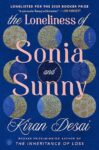
by Kiran Desai, 2025
This book was recommended in either the New York Times or the Denver Post. It’s a novel about two young Indian adults living in the United States, away from their childhood home and culture. The character of Sonia, a beautiful Indian young lady is front and center. Her family in India, grandparents, spinster Aunt, mama and papa, are drawn out so intricately, each one of them. I realize that Adam’s grandma, Nguyen Thi Tram (Vietnamese), being called Ba came from Manu’s Papa’s Indian side. Ba is the name Sonia’s grandma is called.
The author won the Booker Prize and the National Book Critics Circle Award for her book, The Inheritance of Loss. I need to read that one. I loved this book for the characters of Sonia and Sunny and the settings where they are happiest, in Goa, by the ocean; and for Sunny, in the little Mexican village by the ocean. I didn’t enjoy the devil talisman, the ghost hound, and the fantasy and dark spirituality. I despised the character of Ilan de Toorjen Foss, the psychotic artist, who wooed, but then abused and almost destroyed Sonia.
Sonia is a beautiful young Indian women, all alone in the United States in the dead of winter. She’s so lonely during the winter. She meets a mysterious older man, Ilan de Toorjen Foss. He cures her loneliness. He’s rich. He’s an artist. But after a while, he shows his true nature – a maniac – cruel and hurtful. One day, they enter his apartment and his wife is there. She kicks out Sonia, kindly and gently, but still kicks her out. Sonia eventually returns to India to help her father who has cancer, but she is tormented and laments the loss of her amulet, a devil talisman she let Ilan borrow. It’s from her grandfather, and it’s very special to her. When she is kicked out of Ilan’s NYC apartment, she takes everything but forgets that most important thing, tucked under the mattress. She asks Ilan for it back once but he refuses to return it.
Sunny is a young Indian man, a journalist working the night-shift for the AP, in New York City. He has an American girlfriend named Ulla. They are constantly comparing and contrasting their different cultures. Ulla eventually leaves Sunny while he is in India for his best friend’s wedding. She packs up every little thing in the apartment and doesn’t leave a note. He comes home to exactly his half of everything, anything he paid for, etc. Very hurtful.
Sonia and Sunny’s Indian families make up a large part of this book. Each person loves and cares deeply but they are also full of petty jealousies and grievances.
Sonia is beautiful, talented, and honest. Her talent is in writing. But her affair with the cruel Ilan almost destroys her. Sunny is a sweet and honest young man. They were to be an arranged marriage but Sunny never saw the picture of Sonia, and he never took it seriously. They meet accidentally and hit it off. They are two peas in a pod. But a ghost hound haunts Sonia. When they are in the ocean in Goa, a beautiful place, they almost drown from rip tides and then a ghost hound chases them and attacks them. Sonia tells Sunny the story of Ilan. Ilan stole the Badal Baba from Sonia. The Badal Baba is the talisman she got from her grandfather, a German painter. It’s some kind of devil amulet. She asked for Ilan to give it back to her and he refused. He got rich and famous because of it. He is a sick bastard. He uses his wealth to lure young women into his life and then traps them, degrading and insulting them, spitting on them, hurting them.
Sunny’s mother, Babita, is immature, refusing to let Sunny live his own life. She didn’t appreciate her husband, Sunny’s father, because he was honest and refused to be corrupted for money. Sunny’s father dies young. She raises Sunny but never lets him be free of her manipulations. She is jealous of Sonia and works to destroy their love. Then, when Babita is living by herself in Goa, fearful and drinking herself to sleep every night, Sonia shows up on her doorstep one evening and they become true, deep friends. It’s beautiful. Sunny is in Mexico living in a peaceful village in a hut by the ocean. He realizes his Mom has released her hold on him. He realizes he must get Sonia’s Badal Baba back from Ilan. He travels to Ilan’s Mexican estate in the middle of nowhere and pretends he is a journalist. Ilan starts out cocky and confident, but then becomes angry at Sunny and tells him to get the F out. Sunny leaves and sits under a tree. This is in the middle of nowhere in Mexico. He sees Ilan appear out of nowhere and head off into the distance. Sunny discovers the secret entrance into his compound. He sneaks in. The young lady that Ilan is now using, is fearful for her life but she allows Sunny to look for his journal (ostensibly). Sunny breaks into the chapel where Ilan is hiding the talisman, he finds it, puts it around his neck, and takes a paintbrush and paints black a painting of the eyes of a woman crying by the ocean, which is Sonia. Sunny escapes before Ilan returns.
Sunny returns to India, to Goa, to the love of his life, and they live happily ever after.
The book is 670 pages long. It’s focus is on how human love can save a person; save them from crushing loneliness. Everything is bearable when you have another with whom to love and share life. I like that, but it is missing the love of God, Who is always with us and will never forsake us. For God so loved the world that he gave His one and only Son, that whoever believes in Him, shall not perish but have eternal life. God’s love is with us. God has conquered the darkness and the darkness will never overcome it. This book embraces the darkness and gives it more power than it has. Human love is presented as the cure. It’s not, but I do like the notion of strong and honest attachment between people. That’s beautiful. Sunny and Sonia were completely honest with one another. Sonia told him the horror story, let it all out to him. Babita poured her heart out to Sonia, confessed all of her guilty secrets that she had been holding inside. Their honesty to each other cleared the air, dispelled their fears and formed a bond between them that was pure and lovely.
Here are some of the beautiful sentences:
page 6, Sonia is talking with her grandparents long distance and she is crying because she is so lonely. “Sonia tried to explain. “I’ve ballooned in my own head. I cannot stop thinking about myself and my problems. I’m dreading the winter. In the dark and cold, it will get worse—“”
Page 81, Sunny is leaving his apartment after a fight with his girlfriend, Ulla, (white American):
“At nine P.M., Sunny fled for the subway wishing he were as uncoupled as the purple wind that blew through the city. Even in this country, where he’d assumed love was different from the Indian version, it was not a private endeavor, but all about being a public event. If you didn’t stamp and stamp love with legitimacy and acknowledgment, and stamp it some more, silver and gold, with further legalities and recognitions, the ghost of future lost love infiltrated and your love became irrevocably unformed, the lack folded into its substance.”
Page 90: “Sunny sipped his Basque wine. Secretly he was thinking that this woman had some nerve to go from her New York City apartment – no doubt equipped with a stove, microwave, toaster, fridge, blender, coffeemaker, hair dryer, vacuum cleaner, television, computer, music system, heater, fan, air conditioner, boiler, furnace, if not also a bicycle or car – to tell women in India to cook their rice in a cardboard box covered with silver reflective paper so as to prevent deforestation and climate change.”
Page 127: “Papa considered Sonia so precious that he did not cheat on Mama because that in turn would harm Sonia. Although this may not really be the reason her father was not a cheat. Perhaps he simply couldn’t loosen his death grip upon her mother, but that is how it made Sonia feel. Because when someone betrays their spouse, they also betray their daughter and the small life of the house: the trustful dog, the cat with the attitude of a movie star, the houseplant venturing a new leaf, the leftover vegetable soup, the worn socks, the sliver of soap stuck upon the new bar of soap. They betray all these creatures and all these objects that have no idea they’ve been made into a joke, that their lives are actually something other than what they understand them to be. In the end, the betrayer can only scorn such naivete.”
Page 132: “Art is how you climb out of the abyss after you’ve made yourselves into beasts. You have to hook on and rebuild yourself from outside in. This is why it is essential to live in a civilization offering theaters, opera houses, philharmonics, film festivals, cafes, and parks with magazine kiosks and benches upon which to read a newspaper. A city where you can go to a museum of a country that no longer exists, or a lecture on the vibrant culture of tenements, or the 92nd Street Y to hear a great pianist who is still miraculously alive, with a repertoire of expressions of anguished intensity, or a film about an Iranian road worker having an existential crisis. It is important to live where you can turn on public radio and listen to a quick roundup of crimes of war around the world followed by an hour-long conversation with an Irish poet about the consequence of his faith upon his meter. This reassigns you to the calm and rational side of things.”
Pg. 202: “When Mama had asked her why she had stopped writing stories, Sonia had not answered that a person cannot write a story if she looks at the world through someone else’s eyes, if his voice still speaks from inside her brain, if she doesn’t know if her thoughts are her thoughts, if she can’t tell what is true and what is not.”
Pg. 209-210: “If you were easygoing, you’d be fine in India. It was when you lost your temper and were intolerant that the door shut in your face. He himself had given this advice to so many travelers while assuring them that India was even more chaotic and corrupt than their most hellish visions.”
Page 239: “After you’ve cheated someone, you have no option but to turn that person into an ogre so as to justify your own misdeeds.”
Words she used I had to look up:
Deodar: Himalayan cedars – the deodar pines, the deodar scented night. Must smell so good.
Bulbul: medium-sized passerine songbirds.
Nawab: historical, royal title given to Muslim rulers, high-status Indians.
Pg. 282: “Sunny wanted to interview them. Monsanto-patented seeds and farmer suicides were in the news. What would this do to local varieties of carrots, capsicum, and chilies? What would this do to an individual who nurtured seeds in a family farm in the hills? But to be a journalist you have to win over the people you meet, and were they going to trust a man who did not speak to his mother? This violated the laws of the animal-vegetable-mineral kingdoms.”
Pg. 293: “In the bathroom, her toothbrush and her sea algae shampoo, her rosemary mint soap, her almond goat milk lotion, were gone.”
Pg. 294-295: “And when was it that Sunny had learned the United States was about only one thing? In the morning when he turned on public radio it began: race, race, race. When he unfolded the newspaper: race, race, race. the economy, the environment, the journalism, the art, the sport, the war, the water, the wealth gap, the class divide, the summer camp, the prison, the school, the homeless person, the adoption, the birding, the diabetes, the real estate, the mortality rate, the election, the Starbucks restroom, the seat on the plane, the police, the murder, the judge – the conversation came down, in a hammer blow: Race!“
Pg. 298, Sunnyy talking with a bartender named Albana from Albania: “Her family had lived through the dictatorship of Enver Hoxha. To Sunny, the name sounded like an evil comic-book character, but she had known Hoxha as a real-life monster who had deprived his people of heating, meat, sugar, history, philosophy, Dickens, lipstick, and, most of all, privacy. Neighbor spied on neighbor – they knew the loneliness of constant surveillance that denied you your private thoughts. Unwatched solitude was not loneliness, according to Albana’s thinking, but a state of being that was rich and nourishing, naturally sustaining and as precious as sunlight dangling in a quiet room after the war is over.”
Pg. 314: Sunny and his Mom, Babita, are arguing in the expensive apartment of Babita’s New York City friends and Sunny has just accidentally knocked over a priceless statue.
“Then something happened. The god and goddess full over. Babita and Sunny rushed to pick them up. A chip of Parvati’s ear was missing. Had it been missing before?
“They found the chip. “Just stick it back on!” Sunny went out to the store for Krazy Glue, and they stuck it back on. For a moment he kept his finger in the goddess’s ear. They looked at each other, faces bare: Babita’s trip to America had terrified them.
“Before Babita zipped up her suitcase ready to leave for the airport, she hesitated a moment then slipped into her toilet bag one of the magnificent little guest soaps in hexagonal design stamped with a royal bee from a box she had found containing guest soaps. On the flight home she kept returning to her tiny theft. It married her conscience. Why had she wanted it? After causing harm to a priceless antique, she had stolen a bar of soap. It revealed her sad, small state of being to herself.”
Pg. 507: “When you became a real artist, all roads lead to your art: the people, the landscape, the news, the gossip, the suppressed shame, the dream, the flutter in the night of a pelican who should have flown north. A writer itched and itched to put everything into a book, or it became unbearable, the tingling.”
Pg. 516: “From Barra de Navidad, Sunny took a country rattle-trap that labored among the fishing villages of the Costalegre, stopping where country paths emerged and country people stood waiting by the roadside with their heavy sacks and containers. When they arrived at the outskirts of a village on a bay surrounded by low jungle hills, Sunny got off. He tottered to the center and found it was deserted, holding only the enormous sun.
“The murderer will get me, and you’ll be free of your mother.”
“Where to take refuge? The door to a festooned church on one side of the zocalo creaked open. Sunny knelt down before the merciful Virgin, who occupied an alcove to the right of the martyred Christ, and burst into heaving tears, whether from the strain of the journey or from knowing his mother’s death by murder would never free him. The church smelled medicinal and heavenly. He noticed in the dark another on his knees, then several more immobile on the benches. Sunny was a mere speck of pain in an ocean of human pain, upon a planet of striving souls. The people praying alongside him didn’t notice Sunny’s weeping, their own problems so absorbing. It was not very strange in this country, a man who weeps before the Virgin of Guadalupe.”
Pg. 522: “While people may have looked curiously at the gaunt stranger with tomcat eyebrows hobbling by in an Indian fisherman’s gamcha lungi, and while they were kind because they were naturally kind to strangers, their own happiness and sadness were all-consuming, requiring so much chattering, so much gathering, so many funerals, weddings, baptisms, quinceaneras, religious holidays and saints’ days, civic processions, and death and birth anniversaries of revolutionaries and martyrs. There was so much life in this country that Sunny needn’t bother to create one. His life could be simply looking upon life.”
Pg. 527: “When there were no white people around Ulises told Sunny that in all of the six years he’d spent in the United States, only three fucking white people had ever been nice to him. He pulled at his angel curls. “They all fucking come here and buy all the best fucking houses on the beach. Then when we go there, they treat us so fucking badly. When we come back here, to our own village, we have to work for the same fuckers. If they go back to their country, they sell the house they bought from us for nothing to another gringo for a million!”
Pg. 528-529 – villagers are watching what happened on 9/11 on TV in the bar in Mexico. “Afternoon turned into evening, evening to past midnight. They continued watching, beer and tequila flaming down their throats. “Cowards!” yelled Bob. “They are fucking cowards!” He got up, gave a finger to the stars. “Cowards!“
“The creek where a young crocodile had become separated from the other crocodiles in the mangroves smelled putrid as it glided about and stirred the miasma, and a cloud of mosquitoes came swarming. “Well, they are not cowards,” Sunny spoke up, “whatever else they are. It takes guts to fly a plane into the World Trade Center, to attack the U.S. government, to kill yourself and others. They are obviously trying to start a war.”
“Bob shouted, “They are fucking cowards, do you understand? And he pointed at Sunny, as if with a pistol. “You kill innocent people, you are a coward, that is what you are!”
“Sunny understood this was not the time to initiate a tally of innocent civilians killed by American bombs and gunfire. Still, his restraint, his silence, his behaving as if he was mature and Bob was immature, demonstrated he had not been properly affected by the disaster but remained at a distance from it, as he was apparently at a distance from all things.”
Page 557, Sonia is exasperated at the doctor’s and hospital’s lack of care for her father, who is dying of cancer: “What was her anger against? It poured from one thing to another so easily. Fear was like this, too, she remembered. And, sadly, love was like this, so if you had love, it lent its shine and tenderness to all things, and if you did not have love, the lack dulled every quarter of your existence.”
Pg. 563: “She cried for her father being reduced to ashes. She cried for Mama having to face the jackals who blamed her for absolutely everything-when all she had done was walk away when there was not a crumb of love left to stay for. She cried for herself because her parents had not been happy forever after, because you can’t have children if you’re not going to always be happy or if you’re not going to live forever – how could you be so careless and heartless?”
Pg. 564 at Sonia’s Papa’s funeral, cruel, small people: “”He died lonely,” said the neighbors. “He was so brave, poor man. We knew his wife had abandoned him, but we never said a word. We didn’t wish to hurt his feelings.”
“They grimaced little smiles at Sonia. “We knew you had contacts in America, and everyone must be asking why you didn’t take him to Sloan Kettering. . . .Who knows, they may have saved him. May not have, also, but . . .”
“They hoped Sonia would overhear as they remarked to each other, “While her father was dying of cancer, the daughter flew off to holiday in Italy with her boyfriend.” The fact that it was Italy made it monumentally more sinful.
“So where is the boyfriend?”
“Nowhere to be seen,” they said with satisfaction. Fate was playing out the way it should. “Do you remember the Panchsheel Park murders? That was the family of the boy.” They hoped Sonia would be repaid by having to remain alone forever. It would make their lives a little brighter.
“They spoke to Mama not at all but said extra loudly as she passed by, “Here comes the vulture. Now that he is dead, she’s turned up for the money.”
Pg. 633: “While Sunny did not believe in God, he did believe in the devil – therein may lie his life’s problem.”
Pg. 669: “And Sonia knew. When she threw open the two wings of the long, prayerful doors, Sonia and Sunny were too scrawny and crooked to fit into each other’s arms. They saw, with a pang, that they were not quite so beautiful or quite so young. Sunny was angular, his face thinner – but his eyebrows still dove about quizzically. Sonia, too, was gaunt, her shoulders hunched as if they had curved to protect her heart, and her eyes were wary. She was dressed in a caftan too big for her form, and dangling from her ears were cloudy gem earrings of the kind unearthed from a dusty bank locker, destined once upon a time for a daughter, or else a daughter-in-law.
“Sonia said, “But are you real, is this really you?” She rummaged about his embrace and searched his gaze.
“I was beginning to wonder myself,” he said.
“If I am real, or if you are real?”
“Both.”
“She saw about his neck a battered, tarnished case carved with clouds swirling into dragons – -an amulet that must have escaped from supernatural and real disasters through the high Himalayan passes. She reached for it.
[Pg. 670, last paragraph] “If you don’t have love, you don’t properly exist. If you don’t properly exist, you don’t have love. One morning, after the rains had passed, Sunny woke into a memory of being half asleep just the way he was now, of waking into the bloom of affection greater than himself. It was greater because it no longer existed inside himself and Sonia – they were encased within it, the countryside was colored by it, the news was shaded by it, maybe one day even their deaths would be small matters within it. He turned to tell Sonia this, but she was not by his side, nor was she at her desk. He walked down the path that shuffled to the ocean and searched for her amidst the waves. The waves subtracted his thinking. He launched himself into the water and swam straight out to her in the manner of a seabird joining another seabird.”