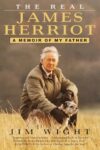
by Jim Wight, 1999
I read this book to find out who the real James Herriot is. It’s written by his son, Jim Wight, who also became a vet. The real James Herriot is James Alfred Wight, born in 1916 in Sunderland, England, but moved to Glasgow, Scotland at 3 weeks of age. He grew up a Glasgow city boy. The only child of a hardworking Mom and Dad who devoted themselves to him. They were not rich. They lived in a tenement in Glasgow but it was one of the nicer tenements. His dad was a musician but that was not how he earned a living. He built ships for his main living. But he played the piano at the movie theaters when they were silent movies. His Mom was an accomplished seamstress and helped support the family with her dressmaking business. “Alf” is what everyone called him. They got Alf a puppy when he was a boy. He named him Don. Alf loved romping in the hills nearby his tenement with his dog. I guess the natural areas that close to Glasgow are all gone now.
As a child in Glasgow, he did go to Sunday School. The children were taken out on walks and taught to spit whenever they passed a Catholic church. But it doesn’t appear he ever went to church again as an adult, or was a Christian in any sense of the word. It was the American publisher, St Martin’s Press, that called his book All Creatures Great and Small when they published it for the Americans. So, everything I thought about James Herriot was incorrect. His real name is James Alfred Wight. He was not a Christian in that he only went to Sunday School when he was a boy. He didn’t attend a church at any time in his adult life, and his son says that he was not religious. The name James Herriot has nothing to do with anyone in his family – it was the name of a soccer goalie he was watching on TV. But, he was a really hard-working vet, and the stories are true except the names have been changed and they are amalgamates. He becomes really, really famous but continues to work as a vet until he is about 75 years old. He chooses to stay in Thirsk and pay huge taxes (over 80%) rather than move to another country. When the conservatives take over England, he gets to keep a little more. He became a household name, beloved the world over, for his heart-warming stories about a country vet in Scotland. His best-selling book is called James Herriot’s Yorkshire, which is responsible for so many tourists coming to Scotland.
When he gets cancer in the early 1990s, he goes through a period of depression. His son writes, “He assured us that the cause of his despondency was not the fact that his days were coming to an end. I could well believe this. Although without any strong religious faith to help him through those difficult times, he had not only always been a selfless man whose concern for the welfare of others transcended any thoughts of his own well-being, but he, himself, had no fear of death.”
He kept himself busy the last years of his life by watching his favorite sports on TV (Tennis, Cricket, Football–Soccer) and old comedies. He read all of his fan mail. He watched old comedies. He read good books – the last book he read before he died was one of his all-time favorites: The Historical Romances of Sir Arthur Conan Doyle.
Back to his childhood:
He’s happy when he has good enough grades to get into the Glasgow Veterinarian School. He was never good at math but he was able to get in. It takes him a long time to finally graduate and then it wasn’t easy to find a job, but he does in Thirsk, Scotland, with an established Vet named Donald Sinclair. Thus begins the partnership that goes for 50 years and provides the stories for all of his books. He started practicing in 1940. Donald Sinclair was eccentric. His brother, Brian Sinclair, was a fun-loving guy who also became a vet. Donald Sinclair is Siegfried and Brian Sinclair is Tristan in the books Alf would write starting in the 1960s. Alf was an excellent, hard-working vet. He worked day and night – mostly in the farmyards around Thirsk. Alf wanted to serve in the war (WWII) and he did go to training but the ‘anal fistula’ cropped up – some kind of terrible thing that happened to him in his late adolescence and early adulthood – and the Royal Air Force doctors butchered him in surgery down there, and then the Royal Air Force dentists pulled out healthy teeth rather than infected teeth, and they sent him back home, so he never got to serve his country in WWII. He says the ‘anal fistula’ probably saved his life. It caused him so many problems when he was a youth, though. I guess they are infections from the anal gland that almost always need to be surgically repaired.
I wanted to find out where the name James Herriot came from. When he started writing, he used the name James Walsh, because, as a practicing Vet, he was not allowed to use his real name. It turned out there was a James Walsh who was also a practicing vet, so he had to find another name under which to be published. He was watching football (soccer) on TV one day and the goalie was named Jim Herriot. That ended up being the name he chose for his pen name. He liked the name and there were no vets in the Veterinary Register with that name. So, that is how he became James Herriot, in February of 1969. After writing and re-writing and getting rejection after rejection for about 10 years, he had given up. But his wife said, why don’t you send your book to Michael Joseph, as we were going to do originally? So he did – and they loved it. His first book was called If Only They Could Talk, published January 1972. It was so popular, they asked him for a sequel. He loved writing. He would tap away on the typewriter at night in front of the TV, with the whole family (wife, Joan, and son, Jim, and daughter, Rosie). The second book was called It Shouldn’t Happen to a Vet.
He changed the names and the location and the time period because he didn’t want his real customers to know. His partner, though, Donald Sinclair, was never happy about the books. At one point, he calls Alf and tells him he’s going to sue him. Alf is devastated. This is after Anthony Hopkins portrays Siefried (Donald Sinclair) so beautifully in a movie in 1975. Jim says his dad was devastated but chose to do nothing and it all blew over; just a momentary blip of insanity on Donald Sinclair’s part. He was actually a lot worse in real life, than how Alf portrayed him. It was amazing that Alf could stay with him as a partner for so long. Alf pretty much did all the work.
The two James Herriots (the former soccer goalie and the author) actually meet in person in 1988, after James Herriot (James Alfred Wight) was famous. The goalie is now working in a factory, or something like that, and was not a reader but had heard of James Herriot from the TV and movies. The author gives him a signed copy of one of his books and the soccer goalie gives the author a signed jersey.
Here are a few paragraphs from the last few pages of the book:
“If my father had a gravestone, I would inscribe upon it the advice that we, as his younger colleagues, heard from him time and time again: ‘It’s not what you do, it’s the way that you do it.’
“I am unable to inscribe this lasting tribute to him as he has no headstone; instead, his ashes are scattered among the moorland grass at the top of the Whitestone Cliffs from where a huge area of his beloved North Yorkshire can be seen. Rosie suggested this spot and it is entirely fitting for his final re=sting place. I have stood here for many an hour, looking at the places where my father played out a great slice of his life. His practice, where he toiled manfully among all creatures great and small, is stretched out below, as far as the distant Pennines which first captivated him in those far-off days in 1940. Thirsk, where he brought up his family, and Thirlby, his home for the last eighteen years of his life, are clearly visible but, above all, it is a fresh and clean part of Yorkshire with a breath of the wildness and freedom that was so close to his heart.”
He always had a dog. He loved each and every one of them. When he lost one, he would soon get another and that dog would accompany him on each and every call. He would advise people who lost a dog and were grieving that there was only one thing to do – get another one right away.
More from the last pages:
“The world that James Herriot wrote about has all but disappeared and the countless family farms which James, Siegfried and Tristan visited in their rattly little cars are now few in number. Almost all the fascinating old Yorkshire farmers that James Herriot immortalized are now dead and gone, together with the hard-working bands of farm men with whom he spent many happy hours.”
He is sent a prayer after his father’s death that comforted him. It’s from Henry Scott Holland: “Death is nothing at all. I have only slipped away into the next room…Why should I be out of mind because I am out of sight? I am waiting for you, for an interval, somewhere very near, just round the corner. All is well.”
“As I sat that day with the ‘finest view in England’ stretched before me, I did wonder whether I would ever see my father again. I would give a great deal to be able to do so. I have so much to say to him and countless questions to ask. I do not know and I can only hope.
“There is, however, one thing of which I am certain. James Herriot, the unassuming veterinary surgeon who enthralled millions, was no fictional character. There was a man I knew, who possessed all the virtues of the famous veterinarian–and more. A totally honest man whose fine sense of humour and air of goodwill towards others ensured that he was respected by all who knew him. A man on whom, after his death, a Yorkshire farmer delivered his final verdict: ‘Aye, he were a right decent feller.’ That man was James Alfred Wight.”