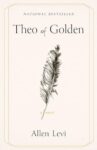
by Allen Levi, 2023
Ben and Lola gave this book to Wayne for me to read when he was over there telling them about the sidewalk replacement that was going to happen. They both loved this book and wanted me to read it. They said it was “uplifting” and “heartwarming.” I loved it! It was uplifting and heartwarming!
It’s about an 87 year-old man named Theo who moves to Golden, a university town by the Oxbow River in America’s southeast. He is a mystery. He loves good coffee and there is a coffee shop near his hotel called The Chalice. On the walls of this coffee shop are hand-drawn portraits of customers – 92 of them – that are incredible; the way the artist was able to render emotions in their eyes and faces. Theo marvels at them, and the low price of each, only $125, and the fact that they aren’t flying off the walls. He works with Shep, the owner of the coffee shop, and he begins purchasing the portraits and writing letters to the subjects, one-by-one, and meeting them at the fountain, on a bench, ‘he is the extraordinarily handsome older gentleman with a green flat cap.”
Theo is very loving and kind. He befriends all of the people he meets, and helps them out. It seems money is no object for him. He moves from the hotel to a beautiful 3rd floor apartment in the Ponder Building. I love the description of this beautiful apartment. Theo has no trouble walking up 3 flights of stairs to get to it. He ends up spending a year in this apartment, becoming friends with many people.
Asher – the artist who draws the portraits. He is a kind and loving man to all. Asher’s niece, Minnette, whose father is a brute – all he cares about is money. Minnette can never please her father, but Asher is her uncle and he shows her what love is. Minnette’s portrait is the first portrait Theo purchases and the first person he writes to and invites to meet him on the bench at the fountain. Minnette and her husband decide to come to the fountain together, because, honestly, both she and her husband are suspicious. They get separated and Minnette goes ahead and meets with Theo on her own. Her husband sees them talking together and watches from a distance. All is well and they become beloved friends of Theo’s, and Theo’s kindness changes them. This story is repeated with each portrait recipient. Each one is invited to come and meet Theo and receive a gift. There is Ellen – the homeless woman who rides her bike around town and sometimes sleeps at the Mission, and sometimes sleeps who knows where. There is Tony – the bookseller, who owns a messy book store and is a smart-alec. There is Simone, a brilliant cellist who walks to class with his cello on his back. There is Kendrick and his daughter Lamisha. Lamisha is severely injured and her mother (Kendrick’s wife) is killed when another driver falls asleep at the wheel and runs into them. Kendrick is a night janitor. Lamisha is often undergoing surgery on her leg and Kendrick and his mother take turns being with her – Kendrick during the day, his mother during the night. Sometimes they stay in the hospital so they are always there with Lamisha. When Theo finds out the story, he hires the best doctor in the world to take over the care of Lamisha. He pays for everything. Then, the driver, who has been in jail for a year, comes to trial, and Kendrick and Lamisha find out his story – it breaks their hearts and Kendrick tells Theo about it. The driver was an immigrant from Guatemala who had worked as a bricklayer for 14 years. He got deported but comes right back – why? Because he has a wife and little girl he loves and he must get back to them. He drives all night, falls asleep at the wheel and kills Kendrick’s wife and injures Lamisha, Kendrick’s daughter. They can see by his tears and his hands in prayer that he is deeply, deeply sorry. After Kendrick talks to Theo, Kendrick tells the judge and his attorney (Minnette’s husband), that he feels this man has already done enough time. It’s a beautiful part of the story – the love and forgiveness from one to another–all coming about through Theo’s love and care for them.
Everyone wonders who Theo is – no last name, all they know is he’s from Portugal originally. Only one person knows him and his story – that is James Ponder, the owner of the Ponder Building where he has his office and where he allows Theo to rent the beautiful, charming 3rd floor apartment.
In the end, we find out the story of Theo and why he came to Golden. He fell in love with Asher’s mother when they were both young artists living in Spain. He loves her but he is intent on his success and lets her go. She returns to Golden and marries immediately and has a little boy, Asher, and then another child, Pearce (the money-hungry father of Minnette). It turns out, Gammy (Asher’s mother) got pregnant. Asher is Theo’s son. Theo reveals all of this in a long letter to Asher that Asher is given to read by James Ponder. James Ponder is Theo’s confidante. He knows all of the history, he knows why Theo came to Golden. He doesn’t tell a soul while Theo is alive. Theo dies tragically – he falls from the 3rd floor balcony in the middle of the night trying to scream at 3 assailants who are brutally beating both Ellen and then Simone who tried to help Ellen. Theo sees it all – and is trying to scream at them to “STOP, STOP, STOP!” The next thing we know he is a crumpled heap on the sidewalk and a young couple is horrified.
James Ponder reveals all to Theo’s son, Asher, and to the close friends of Theo’s. Theo is actually a famous artist, Zila, who has amassed a fortune and is renown for his generosity and benevolence. We do learn early on that Theo was in a loveless marriage (after Asher’s mother) to an alcoholic woman. They have a daughter, Tita, whom Theo absolutely adores – she is the light of his life. One day, the mother is driving while drunk, with Tita in the car, and has a wreck that kills them both. It takes literally years for Theo to recover. He recovers by walking, and finally by watching a sunset by a river. For the rest of his life, he finds a spot to watch the sunset by a river, every night. He also finds the Lord. This book is decidedly Christian. Theo is a good Christian man. He loves God and he loves others. It is wonderful to me that Ben and Lola wanted me to read this book and that they found it heart-warming and uplifting.
Here are some of my favorite parts:
Page 102: “He rose, clasped his hands behind his back, and went home.
“Looking back on that moment, he realized that, in the time between the quarter hour before sunset and the first star of dusk, somehow under the spell of that April evening in France, his splintered soul had begun to heal. It would happen in fits and starts. It would be a healing that would never, at least in this life, be total or final. But it was the moment when the fever broke for him.
“And the moment when heaven took possession of his soul.
“A host of faint recollections–words from his mother, the Story he had been taught from the priest, fragments of music, images of the Christ that he had pondered in museums around the world, books he had read–all converged in the beauty of that riverside moment and coalesced into a name, a hope, a Love that changed him forever.”
Page 119: “Asher looked at the old man. “Theo, I get the impression you’ve thought about this before. What do you think makes for good art?”
“Theo rested his chin on his right thumb and placed a bent index finger over his bottom lip.
“Yes, I have thought about it. But I don’t know if I have an answer either. Other than this. It might not make a lot of sense, but for anything to be good, truly good, there must be love in it. I’m not even sure I know fully what that means, but the older I get, the more I believe it. There must be love for the gift itself, love for the subject being depicted or the story being told, and love for the audience. Whether the art is sculpture, farming, teaching, lawmaking, medicine, music, or raising a child, if love is not in it–at the very heart of it–it might be skillful, marketable, or popular but I doubt it is truly good. Nothing is what it’s supposed to be if love is not at the core.”
“Theo snickered at himself. “I think I sound like a crazy old man again.”
“Asher shook his head. “Not at all. But I do wonder, Theo, how do you know if something has love in it?”
“Theo nodded. “Yes, yes. That is a question, isn’t it? And I’m not sure I know the answer to that either. But God does.”
Page 151: “I’m so sorry, Ellen, so sorry.”
“You don’t need to apologize, Mr. Theo. It’s not your fault.”
“Maybe not. But maybe yes. Ellen, the older I get, the more convinced I am that every hurt the world has ever known is somehow the fault of every person who ever lived. Maybe not directly and never entirely, but somehow, I fear, we own all of the world’s hurts together.”
Page 178: Theo is entranced watching a fisherman paint a sunset on the banks of the river Douro in Portugal. “Use what you have. Now you. Give me your hand.”
“Theo obeyed. The fisherman put river dirt on the boy’s right thumb. “Now paint.”
“Theo stood motionless, uncertain. The fisherman, a bit more insistently but not unkindly, repeated his instruction.
“Paint. Here, do as I do.”
“By way of example, he dragged his finger left to right, careful not to press too heavily into the canvas. Then he took Theo’s hand and guided his muddy thumb along the painting’s surface.
The fisherman leaned back and chuckled. “Well done. You are now an artist.”
“Theo smiled shyly.
“Now, boy, your dear mom is going to be worried if you don’t get home soon. If she’s upset with you, give her this, and tell her you were painting.”
“The fisherman took the canvas from the easel, handed it to the boy, instructed him to be mindful of the wet paint, then patted his shoulder and pushed him along.
“Theo walked home with the sunset in his hands. When he turned away from the river and into the streets of the town, he looked back a final time to see a small but strong figure in the distance, pulling oars against the current of nickel-plated water.
“For weeks after that evening, Theo returned to the river, expecting and hoping that he might meet the artist again. It was not to be, and Theo wondered if the evening, and the bestowal, had ever really happened.
“Most assuredly, it had.
“On the wall behind his desk in New York City, a framed canvas of western sky and Portuguese riverbank was tangible proof that fishermen paint sunsets and angels are real.”
Page 195, he gives his website where you can get the full text of a story he writes for Lamisha, “The Princess of Titalamish.” His website is allenlevi.com.
Page 207: “Theo continued, “I would guess you’ve read Mr. Wordsworth, perhaps in a literature class at some point in your studies. He once wrote that the best portion of a good person’s life is ‘the little, nameless, unremembered acts of kindness and love.” Tintern Abbey, yes? Little. Nameless. Unremembered. I think it has never been our nature to think that way, but especially now, we like ‘big’ and ‘viral’ and all that. But I think Mr. Wordsworth was right.”
Page 246: Ellen gives him ‘featherwood,’ a gift she made for him out of a piece of wood with holes poked with an ice pick into the top, for him to put feathers into. “They exited the building and were saying their goodbyes on the sidewalk when Ellen reached into her bicycle basket. She pulled out an object with a strip of pink ribbon around it.
“It was a piece of wood, the size and shape of a soup can. Both ends were flat and smooth. On one end, small holes–two or three dozen of them — had been drilled or punched into the wood. The bark of the tree, light gray, was still intact. Theo guessed it was maple or beech.
“Ellen held it in both hands as if it were a trophy, one hand underneath and one encircling it, as she offered it to Theo. She clearly intended that Theo accept it as a gift.
“For me? Well, thank you, Ellen. It’s very kind of you.”
“Do you even know what it is? You might want to know what it is before you thank me.”
“Theo looked at it studiously. Ellen spoke before he could make an incorrect guess.
“It’s called featherwood. I invented it. Here’s how you use it.
“Ellen reached into her basket once again and pulled out another item tied in ribbon. She held it up. “These are feathers I’ve found. I didn’t hurt any birds to get them. They were on the ground, and I just collected ’em.”
“She untied the ribbon. As Theo held the wood, she began to place individual feathers into each small hole. She did so with the carefulness of a florist arranging a bridal bouquet. The result was exquisite. Swatches of gray, brown, rose, red, blue, speckles, and white looked like a forest in miniature, a stand of conifers, broad at the bottoms, narrow at the tops, some tall and slender, others short and stubby.”
Pages 251 – 253, Kendrick is telling Theo out on the bench after midnight one night about the little man from Guatemala on trial: “So, Mr. Theo, when they brought that little man into the courtroom, he wasn’t hardly as big as a kid. He’s a man, older than me, but still just real small. He’s been in jail all this time, and I could tell he was scared to death. Had him in handcuffs, and he can’t talk in English ’cause he’s from Guatemala, so they had to have a woman there who could speak for him and tell him everything we were saying. You could tell he was terrified.”
“Kendrick shook his head and looked at the pavement.
“And when the woman pointed to Lamisha and told him that that was the little girl he hurt, you know what he did? He started crying, I mean crying hard, and he put his hands together and held them up like he was saying a prayer to us, and he started trying to say something to me and Lamisha, real soft, but I don’t know what he was saying ’cause the lawyer was talking to the judge, but I think he was telling me he was sorry. He didn’t look like no monster, Mr. Theo. He was just a sad, little man and scared to death.”
“Theo shook his head. “That dear child.”
“And then the judge and the lawyer did some legal talk and told the little man some things. I didn’t understand it, and he didn’t have no lawyer, so I don’t think he understood it even though the lady tried to tell him. But then they asked him what happened, and he told ’em.
“He said he been living up in Fincher County for fourteen years. He’s a bricklayer. He’s an illegal, but he been working here all that time and never been in no trouble. Somehow he got caught for something, and they sent him back to Guatemala. But he didn’t stay here. He came all the way back.
“And the lawyer told him, ‘You know that’s against the law, don’t you?’ And the little man told him, ‘Yes, sir,’ but he said he had to come back. And the lawyer said, ‘Why did you have to come back?,’ kind of with an attitude, like, ‘Naw, you didn’t have to come back. You could’ve stayed where you belonged.’ And the little man said, ‘Because of my little girl.’
“Mr. Theo, he’s got a little girl, eight years old, just like Lamisha, and she lives in Fincher County. She was born there, and she’s been stayin’ there with her mama till her daddy could get back.
“Mr. Theo, sumpin’s wrong with his little girl — she’s real sick — and he said he had to come back, so he could work and help take care of her. He said they’s no good cancer doctors in Guatemala. Then he said this, Mr. Theo; he said, ‘I love my little girl, and I had to come back’…
“It took him three months, and when he crossed over in Texas, he borrowed a car from somebody, so he could drive home to his family. He drove at night, so he wouldn’t get caught again. And he came through Houston and New Orleans and Mobile and Montgomery, and he was coming through Golden, almost back to Fincher County, and he was tired, and he fell asleep or got drowsy or something. And that’s when he hit Lamisha.
“They had to take him to the hospital, but soon as he got well, they took him to jail. And he’s been there ever since, just a couple miles from here. Mr. Theo, he still hasn’t seen his little girl. Over a year, and still hasn’t seen her yet.”
Theo tells Kendrick to tell the DA (who is Derrick, Minnette’s husband) what he thinks is right – “Just tell him what you think is right, Kendrick. Be as kind as you can. Do that.”
Kendrick’s Grandmother Whitaker tells him, “Baby, they’s justice and they’s mercy. If you not sure what to do and you gotta choose one or the other, I say always go the mercy way. If you make a mistake, make it for mercy. Bad mercy don’t hurt nearly like bad justice, and always remember, the Eye of God can see.”
Page 259, Kendrick is talking to Derrick, the DA, who happened to have put Kendrick in jail for a year for something he didn’t do, without ever once looking him in the face.
“Mr. Derrick, I met this old man a few months ago. Named Mr. Theo. He’s from Portugal. And he gave me a portrait that an artist had done of me. And I learned something from Mr. Theo. God gave us faces so we can see each other better. I used to not look at people’s faces so much. But I’m learning. Just like I’m looking at you right now. Mr. Derrick, eighteen months ago, I hated you. But I never one time looked at your face. But I’m looking now. Mr. Derrick, I believe you’re a good man. I think there’s a lot of goodness down in you.”
Pages 271-273, Theo is telling Tony about how Port Wine is made in Portugal, and only from grapes grown in Portugal. “Port wine was invented by the British, and the port companies are now owned mostly by the Spanish. But only the Douro River Valley of Portugal can make the grapes.”
…”…Three days and nights it took to transport the port to Gaia. Even today, all the port in the world is stored and bottled in the port cellars of Gaia. For ten, twenty, thirty, forty years, the port ages, some ruby, some white, some tawny. All those years in deep sleep, but the port is changing like a chrysalis, letting God take His time to do what only He can do. Water to wine, but slowly. It is all so remarkable.”
…”…There are different categories of port: ruby, white, tawny. These are all blends of many grapes from different vines. But in certain years, grapes of a particular vineyard and particular vines are deemed to be of exceptional quality. We call these ‘vintage.’ They are not blended with anything else. They stand alone.
“Vintage is God’s work. A grower cannot make it happen, and no one knows when a crop will be of such rare excellence. If a grower thinks he has a vintage crop, he sends a sample of his fruit to be evaluated and certified. If approved, voila, vintage. If not, maybe next year. There is no finer drink than vintage port.”
Pages 276-277, Tony is telling Theo about the tour of duty in Vietnam that left him so scarred. He is telling Theo about a fellow Marine, Bobbo, who was a really good guy. They are in a foxhole together and the battle is raging around them. “So, Bobbo’s real religious. We talked some about it but not much. He knew I wasn’t interested in that stuff. But he always had this little New Testament with him, a real little one in his back pocket, and the Psalms were in it. After a few weeks in the jungle, it was a mess. It had dirt and mud and grease all over it. It looked like it’d been through the valley of the shadow of death, just like the rest of us.
“Anyway, when we were in the hole that night, things sort of calmed down, and Bobbo pulled out his New Testament and started reading. I asked him what he was reading, and we started talking about it. He told me what he believed. And Theo, you’ll love this. He said he believed in heaven, the real place, and in Jesus dying on the cross and rising from the dead. And like an idiot, I did my disrespectful smart-ass routine and told him all that stuff sounded crazy to me.
“And then you know what he said? Get this. He agreed with me. He said it sounded crazy to him too, but he still believed it. He didn’t get mad at me.
“But this is the part I really wanted to tell you. He opened his mess kit and had this little bottle – it was made out of blue glass, like a pill bottle or something. He’d filled it with wine back at base before we went out to the jungle. And he had a little piece of white bread too. And he was going to take Communion out of it, right there in the hole. All by himself. I didn’t even know that was permitted, to take Communion all by yourself in a foxhole. I thought you had to be in a church with a preacher or somebody like that.
“But there’s Bobbo in a damn foxhole, in the middle of a war, getting ready to do the Lord’s Supper. And then, get this, Theo.”
“Tony swallowed hard and clenched his jaw. “Get this. Bobbo asked me if I wanted to join him. And he told me a little bit about it, about forgiveness and faith and all that, and I said yes. So, I had my first Communion, and my last, right there. I didn’t really know what I was doing, and I hoped it didn’t get him in trouble with God, but I’ll never forget it. ‘The blood of Christ, shed for you.’ That’s what he said.”
Page 300, Theo flies home to NYC at Christmas-time: “It is rumored that some people take long trips at Christmas simply to get away from the burden of obligatory gift giving and the seasonal rush of activity at home. The strategy seems a sane response to an otherwise insane time of year.
“When Theo left Golden in early December, he might have appeared to be one of those people, a refugee from the excesses of the holidays. In fact, and much to the contrary, he had taken pains to somehow remain present with friends in Golden during his absence, meaning that he bought gifts well in advance to be delivered while he was away.”
To Simone, he gave a bow made of Pernambuco wood: “…a genuine Emil Werner made of Pernambuco wood from Brazil.”
To eight-year-old Lamisha, he gave “paints, brushes, pencils, drawing pads, and a jeweler’s loupe.” Also, four volumes of The Wingfeather Saga” by Andrew Peterson. And a pair of patent leather blue shoes.
To Ellen, the inventor of featherwood, he gave cordless sander and drill and a foldable handsaw, and wood-burning equipment. He wrote a note to her explaining the thought behind the gifts – many people would like a featherwood of their own – she could make them and sell them.
To Tony, he gave a Vintage Port 1968, the year he returned from Vietnam. He also gave him a signed first edition of an Ernest Hemingway book, that he could sell if he needed to in order to keep the book store (The Verbivore) open another week; a joke Tony said to passers-by – buy a book, keep me open another week!
Pages 308-310, Theo has written a Christmas letter to Asher, while Theo is still in NYC: “Speaking of portraits. I heard a lovely homily about “faces” this morning. The pastor offered the opinion that, when we are born, our first instinct –and “far deeper than intention” — is to find a face. Our weak and blurry little eyes, wide open but not yet trained to see, search for something, someone, with which to bond…”
… “I have a close friend who is an eye doctor and a man of great depth. He holds firmly to the belief that the most important (and formative and effortless) thing a parent can do for a baby is to gaze into his or her face, to hold him or her close and engage the eyes. Could anything be simpler? Is anything more profound? Does anything more deeply change parent and child?”
…”It is an imponderable thought that the Giver of Faces, the face of heaven itself, the face for which every heart yearns, became a wee babe, misty eyed and helpless, looking Himself for the tender face of His mother on the night of the angels…”
Page 314-315, spring is coming and azaleas are blooming. “Theo had once assumed that these abundant blooms would be a gift to local beekeepers, until he learned that their nectar, and that of other flowers in the genus rhododendron, was toxic and unsuitable for honey. So toxic, in fact, that, once upon a time, receipt of a black vase filled with azaleas was to receive a well-known death threat.”
Page 356-357, at Theo’s funeral, Father Lundy is speaking: “We honor him today. And we grieve, but not – to quote the Apostle Paul – as those who have no hope. Didn’t Theo speak often of heaven, with an unmistakable longing in his voice and with a clear conviction of its reality and beauty?”
“Heads nodded.
“In Theo’s honor, and in keeping with the hope that expressed itself so radiantly in his life, I read these words of promise from Another, a far greater One who lived obscurely among His neighbors long ago, an Artist Himself, the One who, for Theo, defined life and love and goodness. The One who alone makes us good and wise and happy.”
…”. . . And if it is true that ‘begging is our only wisdom,’ then we beg, dear Lord, that this man’s presence in our lives will not have been in vain but instead that we will perpetuate the obedient faith, the cheerful hope, and the generous love that he made so beautifully visible while he was here among us. Might the light of his countenance, how he loved, and who he loved, inspire us to follow him, even as he followed the Christ, in whose name we pray. Amen.”
Page 359: Father Lundy is telling the mourners the story of Jesus on the road to Emmaus with the two disciples: “He told them the story that many of us think we know, one that we think we’ve all figured out. The wonderful story that, for many of us, has lost any element of wonder. The text tells us that Jesus ‘opened the scriptures’ and brought to life all those words about the everlasting God, about a world made good and beautiful but now horribly ruined, about a rescue that none could possibly have imagined. He told them that story in a way that reawakened wonder in those two fellow travelers.”
Page 361: Father Lundy’s last words to the mourners: “Theo could have come to us with great fanfare. He could have flaunted his importance and impressed us with his great wealth and long list of accomplishments. Instead, he came with anonymous handwritten letters and no last name. Instead, he came, as did His Lord, not to be served but to serve.
“And if you wonder why, if you are mystified that he was so ruthlessly good, let me tell you and you and you…”
“Father Lundy looked at the front section, taking time to linger on the face of each one in Theo’s inner circle.
“He…loved…you.
“And so, I say to you, my friends and neighbors, followers of Christ and those not, if you would honor the memory of Gamez Theophilus Zilavez, then do good, bestow kindness, strive for beauty, seek and find the river that leads to life everlasting, and draw from the fountain that never runs dry.
“Like Theo did.
“For heaven’s sake.
“Amen.”
Page 384, last paragraph of the book: “On the first anniversary of Theo’s death, Tony had a plaque embedded in Theo’s bench at the Fedder [the name of the fountain]. All who read it are told that this was a place where heaven and earth met in the form of an old Portuguese man. They are told that all, who choose to be, are capable of saintliness. They are also told that faith, hope, and love endure, but the greatest of these is love.”
A beautiful book about a good and true Christian! Thank you, Allen Levi! Thank you, Ben and Lola, for giving it to me to read, and for the fact that you found it uplifting and heart-warming! Where did you find out about it? Lola said a lady from church (UU) named Kay Williams said – here, you need to read this and so does Ben! Lola said she thinks it is popular in book clubs now, too.
Here is Simone’s playlist from his concert given for his Master’s degree:
- Toccata capricciosa, Opus 36 by Miklos Rozsa
- Bach Cello Suite No. 1 in G Major
- Sonata by Eugene Ysaye – 4 sections
- Formazioni by Attila Bozay-4 minutes (atonal, dissonant, arrhythmic)
- Requiebros by Gaspar Cassado
- Dvorak’s Lasst Mich Allein
- Carnival of the Animals; the Swan by Camille Saint-Saens